As President Bola Tinubu marked his second year in office, the need for the economic and political empowerment of young Nigerians took centre stage at the 2025 Channels Youth Forum.
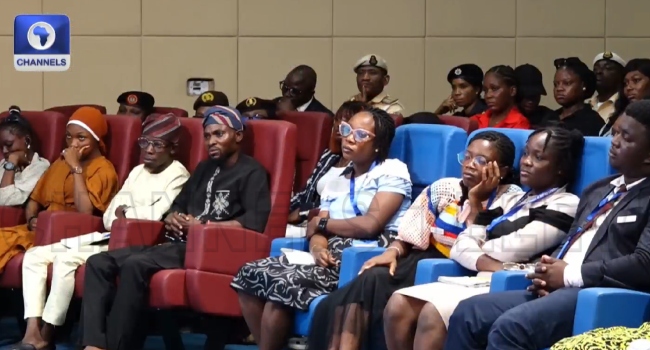
The programme, which aired live on Thursday, featured discussions with experts, youths, and political leaders on issues affecting young Nigerians in different areas, including education, health, business, and the creative industry, among others.
The programme had the theme, ‘Pressing Issues Affecting Nigeria’s Youth’.
Among the panelists were the Minister of Interior, Olubunmi Tunji-Ojo; Minister of Communications, Innovation and Digital Economy, Bosun Tijani; Minister of Youth Development, Ayodele Olawande; and the Minister of State for Industry, John Enoh, who gave insights into ongoing government efforts to tackle the challenges facing the youth.
Tap Into AI, Digital Economy, Minister Tells Youths
While fielding questions from young participants drawn from different parts of the country, the Minister of Communications, Innovation, and Digital Economy advised Nigerians to take advantage of the opportunities in the use of artificial intelligence.
“Do not listen to naysayers, do not participate in those who are wondering if this is a government that is there to serve them. You live in a time of artificial intelligence.
“You don’t even need help. Go into your ChatGPT or any generating AI of your choice,” Tijani said.
He said indigenous manufacturers will find it difficult to compete with their foreign counterparts without the policy being put in place by the government.
Nigeria-First Policy
The Minister of Interior, Olubunmi Tunji-Ojo, said the Nigeria-first policy introduced by the President would return the country industrialisation.
According to him, indigenous manufacturers will find it difficult to compete with their foreign counterparts without the policy being put in place by the government.
READ ALSO: Registration Portal For National Youth Summit Ready Soon — Youth Minister
“Two things that make me happy about being part of this administration. One is the issue of Nigeria First because that is the real way back for industrialisation,” Tunji-Ojo said during the programme.
“If you do not have that as a policy, there is no way that indigenous manufacturers will compete with people coming from China where there is cheaper labour, and electricity.
“So, for us to be able to protect the local industry, Nigeria First, that shows a president who is looking inwards and looking towards backward integration,” he added.
The minister further stated that the second crucial policy of the Tinubu administration was the naira-for-crude policy, which he said had helped stabilise the price of petrol in Nigeria.
“Today we are no longer depending on the issue of foreign exchange. And that is the reason you have seen the naira being stable for some time now, ₦1,500 or ₦1,600,” he said.
Earlier this month, the Federal Executive Council (FEC) approved a Nigeria First economic policy targeted at prioritising the use of locally manufactured goods and services in all government procurement.
Announcing the policy after the FEC meeting in Abuja on May 5, Nigeria’s Minister of Information and National Orientation, Mohammed Idris, said the policy means Nigeria comes first in all procurement processes.
Tunji-Ojo said that it was unfortunate that President Tinubu was left to make decisions that should have been taken decades ago by Nigeria’s past leaders.
Minister Recounts Dad’s Death
While speaking about his childhood, the minister recalled how his father died in Kaduna State in 1992.
He said his dad was killed in a religious crisis in the North-West state when he (the minister) was just 10 years old.
READ ALSO: Reps Committee Threatens Revocation Of Licenses For Defaulting Quarry Operators
The minister explained that he had to continue his childhood under his mother who raised him alongside his other siblings.
“I lost my dad because of issues that had to do with internal security. My dad was killed due to religious whatever, he was coming from church and was killed in Kaduna in 1992.
“That threw me off balance and brought me back to the cradle and it was tough growing up with my mother,” he said.
The minister, however, stated that despite the situation he faced, he made up his mind to face his struggles and run a successful business before joining the public sector.
Portal For Youth Summit
On his part, the Minister of Youth Development, Ayodele Olawande, said that the government would soon launch a registration portal for the proposed national youth summit.
Olawande said that the portal would enable young Nigerians from different parts of the country to participate in the 30-day conference.
He, however, did not give a specific date.
READ ALSO: Confab: Govt Just Wants To Compensate Seyi Tinubu And Friends, Sowore Alleges
Olawande said though young Nigerians were eager to participate in the conference, nothing could be gained without proper planning.
“My generation wants things quick. But I’ve also realised that there is nothing you can gain without proper planning. So for us, in a couple of days, we are going to come out with the first layer of it, which is the launching of a portal because we want transparency.
“A lot of people have said that this confab is all about politics. I am a politician, no doubt, but again, we want to do it differently for the first time and we want to see whether we can get – which we are going to get – a different result,” he said.
“We are going to launch a website. People should register. The President approved 30 days and that is four weeks. In the first week, we want to see how we can engage the young people in all the federal constituencies we have.
“We want to see how we will go from there to the six geopolitical zones we have; we want to see how we can engage them,” he added.
The minister also said that the implementation of the resolutions from the summit would be done in legislative and administrative ways.
“This structure is simple. Even at the committee level, nobody is on the committee as an individual. We want to make sure that at the end of the conference, I should be able to provide the communiqué at FEC and say, ‘This is an executive direction. It should be passed.’”
READ ALSO: #NigeriaAt64: Tinubu Convokes 30-Day National Youth Confab
Confab For Meaningful Dialogue
During Nigeria’s 64th Independence Day Anniversary Broadcast on October 1, 2024, Tinubu announced a 30-day confab for youths in the country to discuss and address challenges confronting them.
He explained that the modalities of this confab and the selection of delegates would be designed in close consultation with young people through their representatives.
The President also said that the government would thoroughly consider and implement the recommendations and outcomes from the forum as part of his administration’s efforts to build a more inclusive, prosperous, and united Nigeria.
Closure Of Industries Halted
Similarly, the Minister of State for Industry, John Enoh, said the Federal Government was tackling most of the issues responsible for the shutdown or exit of industries in the country.
According to him, issues regarding power, infrastructure, bureaucratic bottlenecks, and ease of doing business are being tackled by the government and has brought back confidence among industrialists.
“All those challenges and problems were that the reasons why industries closed shops and left, the number that did, we had a thematic area on power, infrastructure, affordable short-term finance, bureaucratic bottlenecks, and ease of doing business, all of these things we are tackling.
“And I can assure you that the kind of confidence that this government has brought in itself has stopped the closure of industries, has given more confidence for further industrial growth and doing more to restore confidence,” Enoh said.
READ ALSO: Nigeria First Policy Will Take Us Back To Industrialisation — Interior Minister
He stated that Tinubu recognised the importance of industry in the economy, which is why, after one year, instead of having a single minister in charge of trade and investment, he appointed him to oversee the industry.
Enoh further noted that in the two years of this administration, there have been no reports of industries shutting down or leaving the country.
‘Nigeria Can Compete Globally In Agriculture’
Also speaking during the programme, the Founder of the Canadian Black Farmers Association, Toyin Kayo-Ajayi, has said that Nigeria can compete globally in the agricultural sector if it harnesses its abundant resources.
Kayo-Ajayi said that agricultural products like vegetables and yam grown in Nigeria are highly sought after in countries across the world.
He said, “In the next 10 years, Nigeria is going to be a very beautiful, industrial country; I will tell all the youth this. I am even planning to move back home.
“We are so blessed in Nigeria. Here (in Canada), I had to create the weather that we have in Nigeria. I just created loamy soil in Nigeria; I am about to package it in bags and sell it across Canada.
READ ALSO: Nigeria Rich In Agriculture, Has No Business In Poverty — Gov Bago
“With agriculture alone in Nigeria, we can control a lot of things globally. Our vegetables are actually herbs and I am doing research on that.
“What I am doing here is trying to grow yam in Canada. I have to control the environment but we have it in surplus (in Nigeria).”
While recounting his journey into agriculture, he faulted the notion that farming was exclusive to those who could do well academically.
“What discouraged me from farming in Nigeria was that when I was in school, we were told, ‘If you don’t study, you are going to be a farmer. It sounded like a curse.
“Even from the age of five, six, seven, I went to the farm with my grandparents, and I saw the benefits of farming; that is one profession that will not go out of style,” he added.
How Govt Can Save Songs From Pirates — Harrysong
Meanwhile, Nigerian singer, Harrysong, has urged the government to put proper systems in place to protect artists’ work and tackle widespread music piracy.
The Afrobeats star made this call during a panel discussion on the creative sector, said government intervention was crucial in solving these problems, and called for open dialogue between policymakers and experienced industry players.
“The government must engage those who understand the business. If we can have that conversation and they are truly willing to address the issues, I believe we’ll make progress,” he said.
The ‘Reggae Blues’ crooner emphasised the need for a proper structure to ensure transparency and accountability within the industry.
Without such systems, he noted, it becomes difficult to reinvest earnings locally or to host profitable concerts in Nigeria.
“We need a structure that locks this system so that we know what goes in and what comes out. If we can protect the music, we can sell the tickets. But if the songs are pirated, we can’t recoup investments or plan shows confidently,” he explained.
Artists Struggling
Harrysong also lamented that Nigerian artists struggle to generate income from their local fan base due to widespread music piracy, pushing many to seek financial opportunities abroad.
“Most of the time, you’ll hear musicians here in Nigeria complain that our people don’t buy tickets.
“People outside the country pay to buy the music; they stream, they subscribe. But our people at home hack the sound. So you don’t even make back the money you invested in that particular song,” he said.
The singer explained that artists often rely on earnings from countries like the United Kingdom, where platforms like iTunes and Spotify offer transparent revenue systems.
“When you check your iTunes backup, from London, from the UK, from different countries, you’ll see how much people are buying the music. “Meanwhile, Nigerians here try to cut corners to get the same song for free. That’s where piracy comes in,” he said.
For years, Nigeria’s music industry—particularly the Afrobeats genre—has gained massive global recognition, with several homegrown stars dominating international charts and stages.
However, this rise to fame has come with a trade-off. Many Nigerian artists are now shifting focus to international markets, where stronger digital infrastructure and copyright protections allow them to earn more from their music.
For stars like Asake and Wizkid, selling out global venues like the O2 Arena in London has become the new measure of success, seen as a greater feat than hosting concerts on home soil.
But in a bid to reverse this trend, the Lagos State Government, in 2024, announced plans to build a 12,000-capacity entertainment arena by December 2025.
Why Movie Streamers Left Nollywood – Akinmolayan
Similarly, Nollywood filmmaker, Niyi Akinmolayan, has attributed the withdrawal of some international movie streamers, such as Netflix and Amazon, from the Nigerian market to the devaluation of the naira.
According to Akinmolayan, the President’s move to devalue the naira was the major reason the streamers left.
He also blamed the government for not doing anything the cushion the effect of the withdrawal of these streamers.
“When the big streamers pulled out of the market, the Netflix and Amazons, we the filmmakers just woke up and saw emails and we were like, this isn’t just some random companies, the government is aware, the government tax these people, how come the government isn’t even aware of some of these changes because that made a big shift of how we are now doing the productions that we are doing?
“Typically, people will make films and they know that there is a revenue stream that is coming down the line but that is gone. The government didn’t do anything to caution that, the reason they left was because of the devaluation of the naira and the fact that it didn’t make any sense to be paying the amount they are paying for licence and it became a big deal,” Akinmolayan said.
Content Creator Decries Harassment
However, a content creator, Eric Gugua, decried the continued harassment of online entertainers by security agents, calling for an end to such menace in the country.
Gugua, who is a Nigerian digital creator, blockchain expert, and educator who is known for his engaging content and ability to simplify complex technical concepts, called for policies that would protect creatives.
READ ALSO: Nigeria Can Compete Globally In Agriculture — Kayo-Ajayi, Canada-Based Entrepreneur
“In terms of protection, creators go through a lot of stuff. This is a space that is still growing. In terms of protection, policies need to come into place that particularly take people in this space into consideration, he said.
“When creators go out to shoot content, they are constantly harassed. If it is not from people in the locality, it is from law enforcement (agents),” he added.
Meanwhile, Nigerians shared their thoughts on the issues raised on the programme.
They also called for policies that will address the challenges.