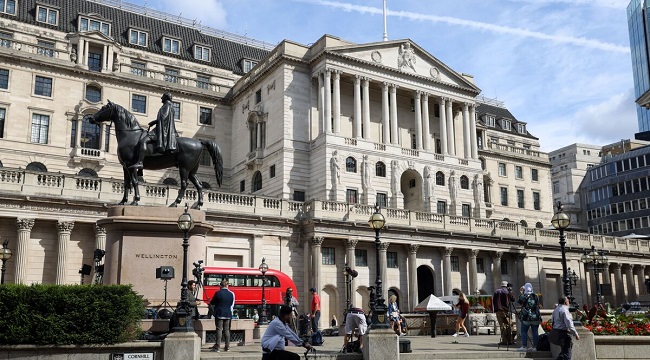
The Bank of England looks set this week to slow the 100 billion-pound-a-year pace at which it reduces its government bond holdings following increased volatility in bond markets, while keeping its main interest rate on hold.
Although the central bank views the pace of quantitative tightening as having little impact on the wider economy, it is closely watched by financial markets, where some blame it for pushing up British government borrowing costs, Reuters reports.
The BoE is alone among major central banks in conducting outright sales of the government bonds it bought to boost the economy in the years after the 2008 global financial crisis, rather than just letting them mature.
Since 2022, the BoE has reduced its gilt holdings from 875 billion pounds ($1.2 trillion) to 558 billion pounds, and for the past two years, it has offloaded gilts at a pace of 100 billion pounds a year.
The BoE has given little away about its thinking, with Governor Andrew Bailey telling lawmakers earlier this month that the decision remained “open”.
But a Reuters poll showed economists expect the Monetary Policy Committee this week to slow the pace to a median 67.5 billion pounds – a bigger drop than the fall to 72 billion pounds in the Bank of England’s own poll in August.
“If they leave it unreduced, the market will sell off significantly,” the report quoted Tomasz Wieladek, chief European economist at fund manager T. Rowe Price.
British 30-year government bond yields – which move opposite to prices – hit their highest since 1998 on September 3, while new 10-year debt sold at the highest yield since 2008, putting pressure on finance minister Rachel Reeves before her November 26 budget.
However, the BoE estimated last month that its QT to date had only added 0.15-0.25 percentage points to British government borrowing costs.
Wieladek said he thought the BoE would only cut the pace of QT to 80 billion pounds but would halt the sale of longer-dated bonds that had seen the biggest price fall over the past year.
The BoE’s aim is to remove excess cash that has built up in Britain’s financial system due to QE, but it is unclear what the neutral level is. A BoE survey of banks gave a range of 385-540 billion pounds, compared with a current level of around 650 billion.
U.S. stocks ended mixed on Friday, with the Dow dropping about six-tenths of a percent, the S&P 500 closing essentially flat, and the Nasdaq gaining more than four-tenths of a percent to record another record closing high.
Banks’ usage of the BoE’s short-term liquidity facilities last week hit its highest in years, suggesting the neutral level of reserves could be closer than it seems.
The BoE would need to reduce the pace of QT to 49 billion pounds to end active sales completely and achieve QT solely by gilts maturing.
READ ALSO: Trump Demands NATO Halts Russia Oil Purchases Before US Sanctions
But Adam Dent, chief UK rates strategist at Santander CIB, told Reuters that doing so could make the BoE look like it was influenced by political considerations ahead of the budget.
“Continuing QT would therefore be a useful demonstration of independence, and ultimately be a net positive for the country by reinforcing much-needed credibility in the fight against high inflation,” he said.
At 3.8 per cent in July, British inflation was the highest in the Group of Seven advanced economies.
Last month, the BoE cut rates for the fifth time in just over a year, but by a narrow five-four margin.