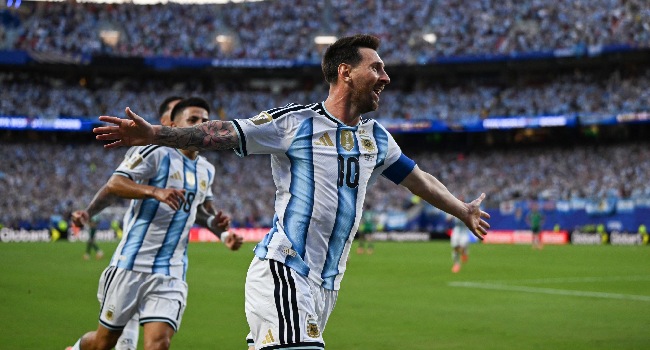
He knew what Lionel Messi was going to do and had a plan to stop it — and then the Argentina captain struck twice anyway in becoming the leading scorer in World Cup history.
Austria coach Ralf Rangnick may not be all that fondly remembered by Manchester United fans, where he pitched up in 2021-2022.
But at 67 the German coach is vastly experienced and also widely admired in football.
Rangnick has revived the Austrian team since taking over in 2022, and they beat debutants Jordan 3-1 to launch their World Cup last week in North America.
Talking ahead of his side’s group match on Monday against reigning champions Argentina in Texas, Rangnick spoke about the latest iteration of Messi, who turns 39 on Wednesday.
“Lionel Messi maybe doesn’t put in the same legwork as in the past,” said Rangnick.
“He likes to stay on the side, and sometimes he likes to stop in front of the goal, in the offside position.
“That doesn’t mean that they have one man less, but they have one man less that works in the counter-pressing.
“But that makes him so dangerous, because he might be in a position, free in a position, and we need to be prepared for that.
“We shouldn’t have too many transition moments, and not allow transition moments and not allow him to be free to accept the ball.”
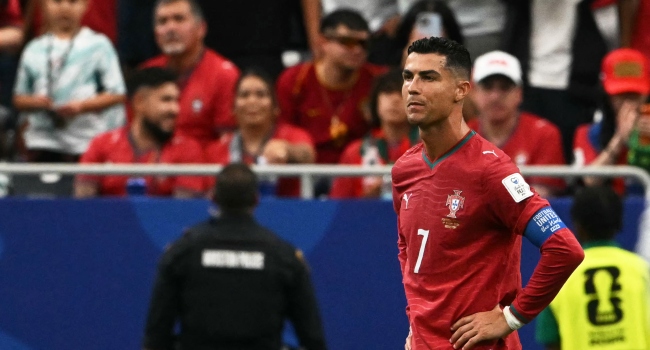
READ ALSO: Portugal Coach Defends ‘Role Model’ Ronaldo Despite Slow World Cup Start
‘Very angry’

That notion unravelled in front of a frenzied crowd of 70,000 dominated by Argentina fans decked out in light blue and white.
Messi, pulled an early penalty wide to pass up the chance to move clear of Miroslav Klose for the most World Cup goals.
Messi said afterwards that he was “very angry” with himself and he twice came close after that to scoring, only for Austria captain David Alaba to twice deny him.
And then came the big moment, Messi sweeping in on 38 minutes after being set up by Facundo Medina.
Just like Rangnick had warned, Messi had ambled into space and was all alone to score with a trademark swing of his left foot.
It was his 17th World Cup goal and 18 arrived when Messi pounced again in the fifth minute of injury time.
This time the veteran squeezed home as several defenders threw themselves desperately at the ball.
Messi, at his sixth World Cup, was still going strong in the 95th minute.
It took the maestro to five goals at this edition, having hit a hat-trick in a 3-0 win over Algeria.
That was Messi’s first treble at a World Cup.
Last Messi the best one?
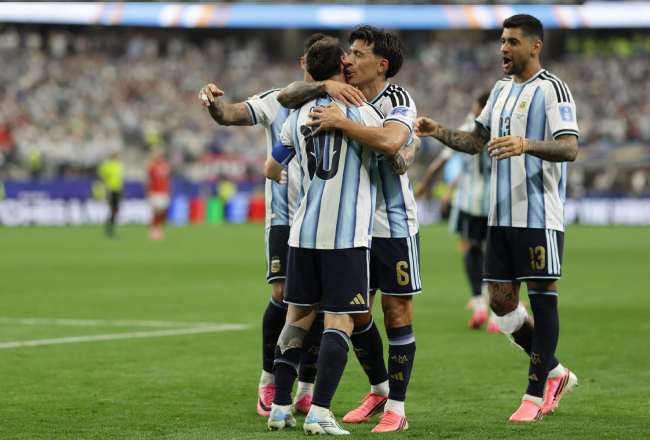
Argentina coach Lionel Scaloni, Messi’s team-mate at the 2006 World Cup, has built an ecosystem around Messi to allow his captain to do his thing.
That means letting others do the running around him.
Not that Messi is totally exempt from the dirty work.
“Today, when the team was struggling without possession, he put in the work,” said Scaloni.
“You could see his commitment, that speaks volumes about him.”
Renowned Spanish journalist Guillem Balague, who wrote an authoritative biography of Messi, said before the World Cup that this version of the player was “very different” to the one that burst onto the scene with Barcelona in the early 2000s.
“Messi has reinvented himself at least five times to evolve into the player he is now for Argentina and Inter Miami,” Balague wrote in a column for the BBC.
“He has adapted so he can dominate and stay ahead of a game that has always been chasing him,” he added.
He noted how Pablo Aimar, Messi’s childhood idol, once said: “The last Messi is always the best Messi.”
That version is a player that walks more than he runs, said Balague, but “still sees everything first”.
“Critics once used this (lack of running) against him. Now it reads as mastery,” he wrote.
“He is reading the game, conserving energy for the moments that matter.”
AFP