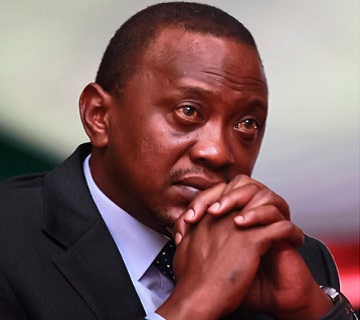
 Prosecutors at the International Criminal Court (ICC) in The Hague have withdrawn charges of crimes against humanity against Kenya’s President Uhuru Kenyatta.
He had been indicted in connection with post-election ethnic violence in 2007-08, in which 1,200 people died.
Mr Kenyatta, who had denied the charges, said he felt “vindicated”.
He said he was “excited” after hearing news on Friday that charges against him at the International Criminal Court had been withdrawn and said he wanted a case against his deputy, William Ruto, dropped too.
He was attending a meeting of officials and business executives when the news broke. In his first comments, he said: “One down, two to go”, a reference to Ruto and another Kenyan also facing charges of crimes against humanity at the court.
He also said he was “excited” and wanted to “run home to my wife” to tell her the news.
The prosecutor’s office said the Kenyan government had refused to hand over evidence vital to the case.
“My conscience is absolutely clear,” he said, adding that his case had been “rushed there without proper investigation”.
Kenyan Foreign Minister Amina Mohamed said her government would try to have two other similar cases thrown out including one involving Deputy President William Ruto.
“As they say, one case down, two more to go,” Mr Kenyatta said on Twitter.
On Wednesday, the ICC had given prosecutors a week to decide whether to pursue their case against Mr Kenyatta or withdraw charges.
Further delays in the case would be “contrary to the interests of justice”, it had said.
On Friday, prosecutors said the evidence had “not improved to such an extent that Mr Kenyatta’s alleged criminal responsibility can be proven beyond reasonable doubt”.
Mr Kenyatta was the first head of state to appear before the court, after he was charged in 2012.
The prosecution repeatedly asked for more time to build its case, saying witnesses had been bribed and intimidated, and the Kenyan government had refused to hand over documents vital to the case.
Human Rights Watch had accused the Kenyan government of acting as a roadblock and “impairing the search for truth”.
Mr Kenyatta denied inciting ethnic violence following the disputed 2007 elections in order to secure victory for then-President Mwai Kibaki.
He has repeatedly accused the ICC of pursuing a political prosecution.
On Friday, he again criticised the legal process, saying: “The prosecutor opted to selectively pursue cases in a blatantly biased manner that served vested interests and undermined justice.
“As a result, the court has had to pay a steep reputational price, which it will continue to face unless a serious and systemic rethinking of the international justice framework is undertaken.”
Mr Kenyatta won Kenya’s presidential elections in 2013, with the backing of Mr Kibaki.
He used the ICC case against him to rally nationalist support by accusing the Dutch-based court of meddling in Kenya’s affairs.
About 1,200 people were killed in the violence in 2007-8 and 600,000 were displaced.