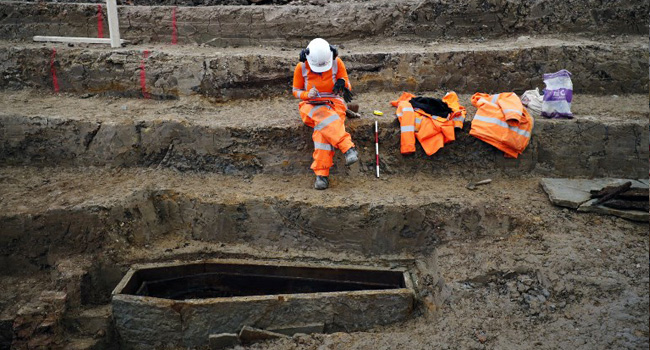
A field archaelogist takes notes on the excavation of a late 18th to mid 19th century cemetery under St James Gardens near Euston train station in London on November 1, 2018 as part of the HS2 high-speed rail project. Tucked behind one of London’s busiest railway stations, a small army of archaeologists shovel thick clay as they clear a vast burial site to make way for a new train line. They have already unearthed about 1,200 of the estimated 40,000 skeletons believed to lie beneath St James Gardens near Euston, which was a cemetery between 1788 and around 1852. It is one of more than 60 archaeological sites created as part of the construction of a new high-speed rail link from London to Birmingham.
Adrian DENNIS / AFP
A field archaelogist takes notes on the excavation of a late 18th to mid 19th century cemetery under St James Gardens near Euston train station in London on November 1, 2018 as part of the HS2 high-speed rail project. Tucked behind one of London’s busiest railway stations, a small army of archaeologists shovel thick clay as they clear a vast burial site to make way for a new train line. They have already unearthed about 1,200 of the estimated 40,000 skeletons believed to lie beneath St James Gardens near Euston, which was a cemetery between 1788 and around 1852. It is one of more than 60 archaeological sites created as part of the construction of a new high-speed rail link from London to Birmingham.
Adrian DENNIS / AFP