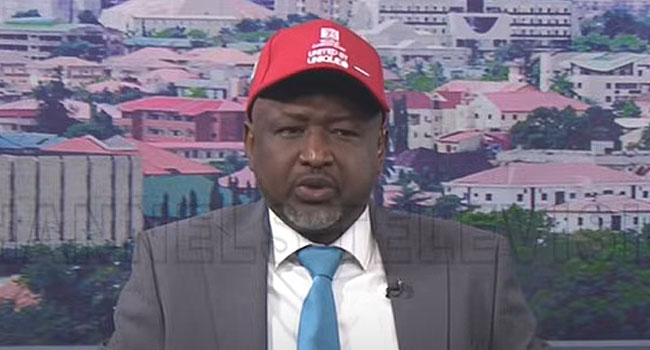
Director General of the National Institute for Cancer Research and Treatment, Dr. Usman Malami Aliyu, who was a guest on Channels Television’s breakfast show, The Morning Brief elaborated on President Tinubu’s investment into the health sector with an emphasis on oncology, plans on cancer screening centres in the six geopolitical zones, amongst others.
Read the interview below:
What exactly should we make of the World Cancer Day 2025?
As we all know, today is World Cancer Day and we have a new theme for this year’s WCD commemoration and that is “United by unique”.
Cancer diagnoses are unique entities, and each patient has a unique story surrounding their diagnosis, the treatment they receive, the devastating news they endure, and the struggles they go through—including various challenges along the way.
The new theme promotes a holistic approach to cancer management. It should no longer be a one-size-fits-all approach; instead, all facets of care must be integrated to ensure comprehensive cancer care. Since every patient is unique, we emphasise that every individual involved in cancer management should adopt a personalised approach tailored to each patient’s specific needs.
In other words, you are expected to see the person first before the patient. By doing so, we strongly believe—according to this year’s theme—that we can provide the holistic care needed for this special type of disease. As mentioned earlier, cancer is not just a disease; it comes with many interconnected challenges—physically, emotionally, and socially.
We have just heard a survivor’s story, and it reinforces the fact that cancer care should go beyond holistic treatment. It must evolve into a more coordinated and personalised care system for these special patients.
Naturally, we are expected to have one clinical oncologist to 250 patients but in Nigeria, due to the Japa syndrome, we have one clinical oncologist to 1800 patients. How easy will it be for that one oncologist to take care of 1800 patients?
This is one of the problems we are facing, not only in Nigeria but also in oncology practices and the care provided by oncologists. If you look at Nigeria’s population, you are correct that there is only one oncologist for at least 1,800 patients. This is a major challenge due to the stringent conditions that specialists face.
A lot of concerns have been raised by these specialists, including issues related to the availability of essential equipment such as treatment machines like linear accelerators, suitable welfare packages for patients, and a conducive working environment for practitioners.
However, I can assure you that with the coming of this administration—the administration of His Excellency, Bola Ahmed Tinubu there has been a noticeable improvement, despite the Japa syndrome that has affected virtually every sector of the country. There has been an increase in the provision of cancer treatment equipment.

Before the advent of this government, there were only about three or four functional cancer treatment centres across the country. However, within the first year of this administration—just last year—Mr. President approved the procurement of six brand-new cancer treatment machines for six centres of excellence within the country. This means the government has more than doubled the provision of these critical machines.
Additionally, this year, the National Institute for Cancer Research and Treatment is planning to introduce state-of-the-art screening services in the six geopolitical zones—a first of its kind. More equipment, including nuclear medicine technology, which is highly needed for specialised cancer treatments, is also being acquired. This includes more linear accelerators to improve the quality of care for cancer patients.
With these improvements, the government is actively working to provide oncologists with the necessary tools for their practice. Many oncologists have expressed concerns, saying, “Yes, I have graduated, but what do you want me to do? If I stay in Nigeria, there are no centres where I can practice what I have learned.” Meanwhile, I have job offers abroad in well-equipped centres with up to six cancer treatment machines, where I can upgrade my skills and advance in my career.
Through these efforts, we hope to retain more oncologists in the country. If you look at most of the centres where this new equipment is being provided, you will notice that newly graduated oncologists are the ones occupying these positions. This means, in some ways, there is now a level of retention in the field of oncology, thanks to the innovations introduced by the current government.
Is this administration’s approach fit for the purpose of ensuring accessibility and affordability for advanced terminal diseases?
If you look at what the Federal Ministry of Health is doing in collaboration with NIKRA through the Federal Ministry of Health, the Honourable Minister for Health and Social Welfare of the Alip Party has a special interest in ensuring that the needed healthcare provisions and services required by our communities are provided at their doorstep. It was through this vision that he decided to introduce a wide-set approach to healthcare services, and cancer is not exempted.
Last year, there was a Cancer Access Program in the country. This Cancer Access Program, which is now under the National Institute for Cancer Research and Treatment, consists of two parts. The first one is what we call the “Cancer Health Fund.” This is a special fund set aside to support indigent patients in accessing cancer treatment in the country. It has been piloted in the six regions, and many have accessed this fund.
We also have another program called “The ENCAP.” Through this initiative, the Federal Ministry of Health, in collaboration with NICRAT, entered into an agreement—an MoU—with pharmaceutical companies that provide chemotherapy and targeted therapy needed by cancer patients. These pharmaceutical companies supply high-quality medications for cancer treatment at 50% of the original cost. In turn, we worked with the Federal Ministry to secure a waiver from NAFDAC and the Immigration Customs Service to facilitate access.
Through this initiative, the government has drastically improved accessibility to cancer treatment. Additionally, I just mentioned the provision of six brand-new cancer treatment equipment, which we hope to complete by the second to third quarter of this year. This will further enhance access to cancer care and improve the availability of services that were previously unavailable in the country.
We are also working on the provision of screening services. We have procured the necessary machines and are currently renovating and constructing sites within the six geopolitical zones. This will ensure that individuals with suspected cancer cases can walk in and get screened. Once screened, if you test positive, we are hopeful that at this stage, we will be able to cure the disease because it is expected to be detected at a very early stage. If you do not feel any symptoms but undergo screening and something is detected, you have a high chance of being cured because it is identified early. Early detection is not only safer but also significantly more affordable. Through these efforts, we hope to improve accessibility to the essential healthcare services that our people need.

Is the screening subsidised? Is it free?
Yes, the Cancer Health Fund is free. All you need to do is inform your doctor that you need these services, and he will assist you in going online to apply for the Cancer Health Fund. However, there are certain criteria you must satisfy before you are allowed to enroll on the platform.
The centres, what states are they?
North-Central – We have Abuja, the National Hospital
North-West – Ahmadu Bello University (ABU), Zaria
North-East – Federal Teaching Hospital, Gombe
South-West – University College Hospital (UCH), Ibadan
South-South – University of Benin Teaching Hospital (UBTH)
South East – University of Nigeria Teaching Hospital (UNTH), Enugu.
All these centres have been providing these services, and we’ve been interfacing with the National Assembly and other philanthropists in the country to improve funding for the Cancer Health Fund. What we got for the fund last year was 200 million, and you know it will not be enough. So, we are hoping to increase it remarkably so that, at least, we will be able to cover more Nigerians with these funds.
Is there a collaboration with States for this Cancer Health Access Program?
I mentioned earlier that what we got for the Cancer Health Fund from the budget was 200 million, so it was minimal. It was out of the wisdom of the Federal Ministry of Health, NICRA, and the agency that currently manages this fund to limit the coverage because of the amount we had—to three cancers: breast, cervical, and prostate cancer.
We limited it to these six. Our hope is that if we get better funding this year, we are going to open our program to include all the tertiary hospitals in the state to be the hub for the republic. Then, we have the sub-hubs, which are the general hospitals within the country that offer some form of cancer treatment services based on surgery.
We also have the feeders. The feeders are the primary healthcare centres that we have in the country. This, we have all completed because we divided the expansion program into phases, and we are done with Phase 1. We are currently in Phase 2, interfacing with the National Assembly to get more funding so that once we have that, we will have a robust referral system. From primary healthcare, you can be referred to a general hospital where you will be able to access some form of healthcare service.
Watch the full chat here: