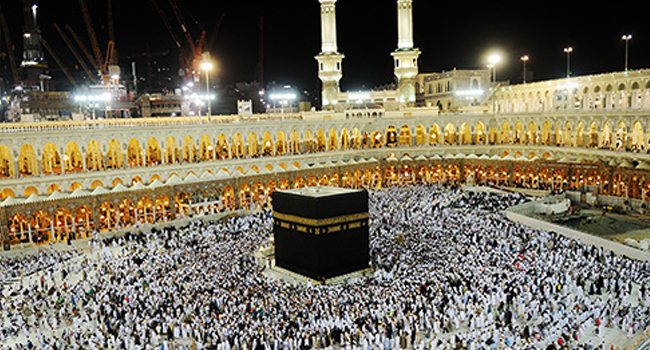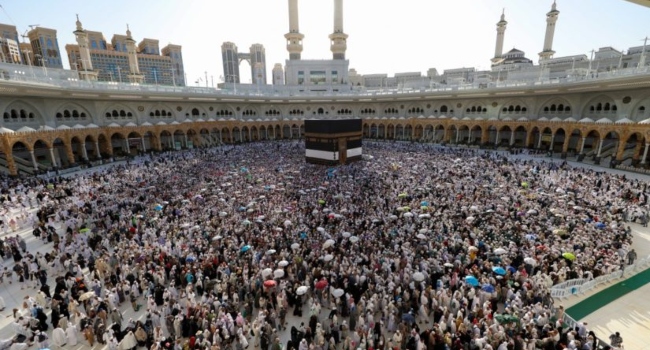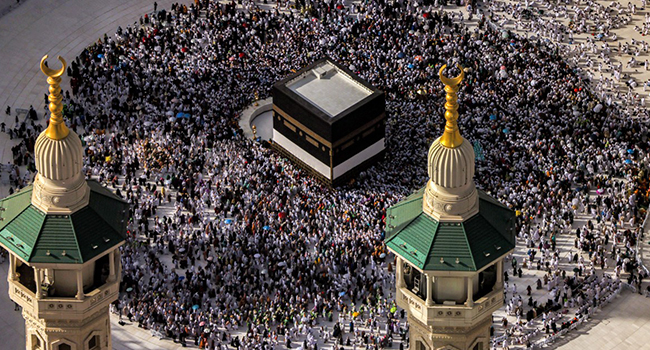
The Saudi Authorities have continued to heighten preparations across sectors to ensure a hitch-free 2025 Hajj exercise and deployed 40,000 security operatives
From security and safety to health and rapid response, teams have been prepped and deployed to tackle any threats that may occur, as authorities have introduced a drone to support firefighting and rescue efforts for the first time.
As part of a multilayered security approach, 40,000 personnel have also been deployed to control the crowd, manage traffic, as well as ensure rapid response and surveillance.
Authorities reveal that over 250,000 illegal pilgrims have been evicted, 415 fake Hajj offices busted, and 109,632 vehicles violating Hajj rules sent back.
The Ministry of Hajj and Umrah, in collaboration with the Council of Senior Scholars and the King Abdulaziz Foundation for Research and Archives (Darah), organized this Grand Hajj Symposium in Jeddah.
The symposium is part of the ministry’s efforts to highlight the concept of capacity in Islamic Sharia as it aims to uphold the objectives of Islamic law.
The 2025 Grand Hajj symposium, which is the 49th edition, featured the participation of ministers, senior scholars, heads of Hajj offices and missions, including Nigeria, as well as specialists from within the Kingdom of Saudi Arabia and abroad.
Not just showcasing diverse scholarly and intellectual experiences, it examined one of the key concepts in contemporary Hajj jurisprudence, fostering knowledge exchange in support of pilgrims.
READ ALSO: Al-Hajj, One Of The Five Pillars Of Islam
The Interior Ministry also held a press conference for the Commanders of the Saudi Security Forces in Makkah as it prepares for a smooth Hajj exercise.
Giving details of preparations as well as technological innovations adopted to achieve a smooth exercise, the General Directorate of Saudi Civil Defense announced that for the first time, a firefighting and response drone will be used for this year’s Hajj.
Named Falcon and enhanced with Artificial Intelligence, the drone has a flight time of 12 hours and can carry a payload of 40 kilogramme, and is prepped to be used in hard-to-access locations.
The National Centre for Security Operations, 911, is set up with more personnel to monitor the security situation and coordinate with security entities to handle emergency security situations.
The spokesperson of the Saudi National Centre for Security Operations, AbdulAzeez Al Ghamdi, disclosed that this year, response time has also been reduced with the adoption of sophisticated infrastructure.
He said, “The unified security system in the Makkah region, 911, has prepared a special plan for the hajj season starting with analyzing the calls of past years of Al-Hajj seasons and expect the calls for this year depending on the numbers, we increased our forces and call takers so we can answer all the calls. We also enhanced the role of the CCTV camera, which monitors all the holy sites.”
“We have the most advanced technologies we answer all the calls in less than 2 seconds. As soon as we get a call, 3 main information show up on the system: the name of the caller, the number, and the location. After that, if there is a report, we send it to the specialized entity in less than 45 seconds.”
Not just focusing attention on security and safety, the authorities have mobilised personnel at the health emergency operations centre in Mina.
The Chief Operations Officer, Medical Referral, Centre Nawfal Aljerian, noted that all measures have been put in place to respond to health emergencies.
He called on pilgrims to take procedures to manage hot temperatures, revealing that there is a reduction in medication delivery time from one hour and twenty minutes to six minutes this year.
“This is a system of care with health authorities to get live information, helping decision makers to reach the proper questions and answers, and to provide proper services at the same time,” he said.
“As a physician and as a emergency physician at this time be careful of heat related illnesses, all Hajjis (pilgrims) try their best to rest when they can rest, stay away from direct sunlight, use umbrellas and drink a lot of water.
He added, “We are using drones this year to deliver medications to certain areas, and that has decreased the time from an hour and twenty minutes to six minutes this year.”
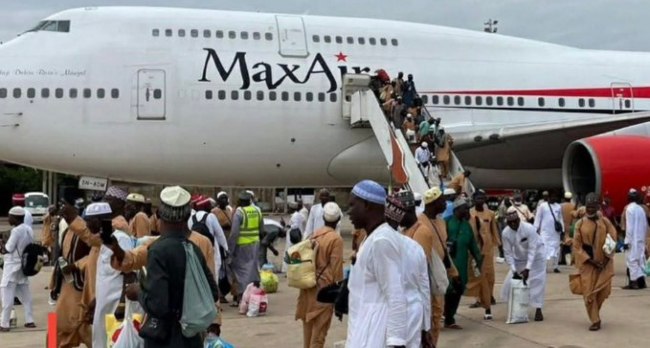
As over one million pilgrims have arrived in the holy land to perform this year’s Hajj, Saudi authorities are staying proactive, they revealed that so far over 250,000 illegal pilgrims have been evicted, about 400 fake Hajj offices bursted and no fewer than 109,000 vehicles violating Hajj rules sent back as unauthorized participation is prohibited.