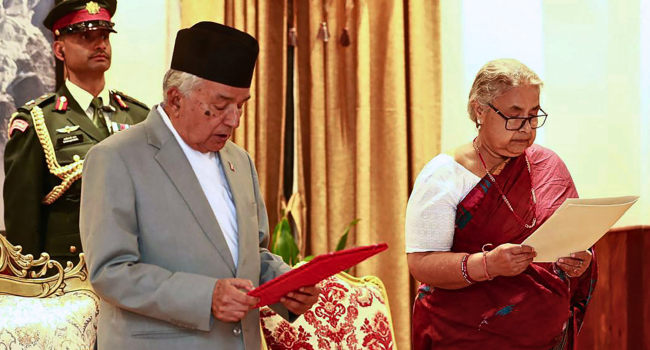
Nepal’s former chief justice Sushila Karki was sworn in on Friday as the country’s prime minister to lead a six-month transition to elections after deadly anti-corruption protests ousted the government.
The previous prime minister resigned on Tuesday as protesters set parliament ablaze.
“I, Sushila Karki… take an oath in the name of the country and the people to fulfil my duty as the prime minister,” the 73-year-old Karki, Nepal’s first woman chief justice, said as she was sworn into office by President Ram Chandra Paudel.
“Congratulations! We wish you success, wish the country success,” Paudel said to Karki after the small ceremony in the presidential palace, attended by diplomats and some former leaders.
Subsequently, officials dissolved parliament and set elections for March 5, 2026.
The Himalayan nation of 30 million people plunged into chaos this week after security forces tried to crush rallies by young anti-corruption protesters.
READ ALSO: Nepal’s Parliament Dissolved, New Elections Set For March 2026
The violence claimed at least 51 lives, the deadliest unrest since the civil war ended and the monarchy was abolished in 2008.
The military took back control of the streets on Wednesday, enforcing a curfew.
Power Shift
The appointment of the judge, known for her independence, comes after two days of intense negotiations by army chief General Ashok Raj Sigdel and Paudel, including with representatives from “Gen Z”, the loose umbrella title of the youth protest movement.
Thousands of young activists had used the online app Discord to debate the next steps — and name Karki as their choice of next leader.
Karki, dressed in a red sari dress, took the oath but did not make a further speech. She smiled and bowed with her hands pressed together repeatedly in traditional greetings.
“It is a moment of victory… finally, the power vacuum has ended,” said Amrita Ban, a Gen Z protester.
“We did it”, key youth protest group Hami Nepal posted on Instagram, calling for unity.
“Honour the lives of those who sacrificed themselves for this moment”.
Neighbouring India said that it welcomed the formation of the interim government and Karki’s appointment.
“We are hopeful that this would help in fostering peace and stability”, New Delhi’s foreign ministry said in a statement.
‘Make A Better Nepal’
Protests worsened Nepal’s economic crisis, with high youth unemployment and GDP per capita at just $1,447.
Police killed at least 21 protesters, mostly on Monday, during a crackdown triggered by a social media ban and corruption.
On Tuesday, protesters set fire to Parliament, major government buildings, and a Hilton Hotel.
KP Sharma Oli, the 73-year-old leader of the Communist Party, then quit as prime minister. Authorities do not know his whereabouts.
Amid the chaos, more than 12,500 escaped prisoners remain at large, police spokesman Binod Ghimire told AFP.
During the uprising, protesters brandished automatic rifles and looted more than 100 guns, which the army later recovered.”
Soldiers patrolled the largely quiet streets of the capital Kathmandu for a third day on Friday.
“I was very afraid, and stayed locked inside my home with family and didn’t leave,” said Naveen Kumar Das, a painter-decorator in his mid-40s.
He was one of many Kathmandu residents who used the brief curfew lift to stock up on supplies.
James Karki, 24, who was among the protesters, said he was hopeful for change ahead.
“We started this movement so we could make a better Nepal,” he said.