The GoNigeria Initiative has announced an expansion of its advocacy efforts, calling for broader reforms aimed at strengthening Nigeria’s democratic foundations beyond periodic elections.
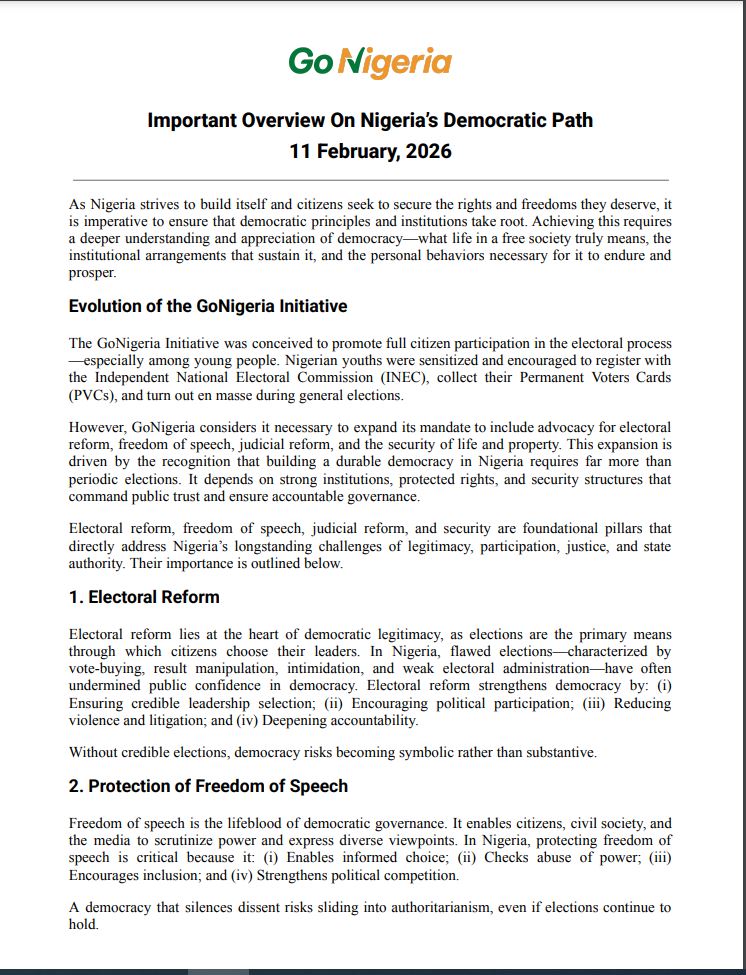
In a statement released on Tuesday, the civic advocacy group said that while elections remain central to democracy, sustainable democratic governance depends on strong institutions, protected freedoms, judicial credibility, and the security of citizens.
Beyond Voter Mobilisation
GoNigeria was initially established to encourage citizen participation in elections, particularly among young Nigerians, through voter registration, collection of Permanent Voter Cards (PVCs), and active participation in the electoral process.
However, the initiative says Nigeria’s democratic experience requires a wider intervention. It has now expanded its mandate to include advocacy for electoral reform, freedom of speech, judicial reform, and improved security.
According to the group, democracy risks becoming symbolic rather than meaningful if these foundational issues are not addressed.
Four Pillars of Democratic Stability
The initiative identified four priority areas it considers essential for a durable democracy:
Electoral Reform:
GoNigeria says credible elections remain the cornerstone of democratic legitimacy, noting that vote-buying, intimidation, and disputed outcomes have historically weakened public confidence in the electoral process.
Freedom of Speech:
The group emphasized that free expression allows citizens, civil society, and the media to scrutinize power, promote inclusion, and strengthen political competition.
Judicial Reform:
An independent and efficient judiciary, the statement noted, is critical for upholding the rule of law, resolving electoral disputes, and protecting fundamental rights.
Security of Life and Property:
The initiative also warned that insecurity — including insurgency, kidnapping, and election-related violence — continues to limit political participation and undermine democratic governance.
Citizens’ Role in Democracy
GoNigeria stressed that democracy depends not only on institutions and laws but also on citizens who understand, value, and actively defend democratic principles.
The group called on Nigerians to participate in ongoing advocacy efforts aimed at strengthening democratic institutions and deepening public trust in governance.
The statement was signed by the Convener, Atedo Peterside, on behalf of the initiative’s advocates drawn from civil society, governance, business, and the creative sector.
See full statement below:

NASS Reforms Efforts
The move came amid a push for reforms in the country’s electoral system. The National Assembly is currently amending the Electoral Act, with the Senate and the House of Representatives already setting up a committee on the bill.
Last year, the House of Representatives approved the proposal, mandating the electronic transmission of results.
The approved clause said “presiding officer shall electronically transmit the results from each polling unit to the IREV portal in real time, and such transmission shall be done after the prescribed form EC8A has been signed and stamped by the presiding officer and/or countersigned by the candidates or polling unit agents, where available at the polling unit”.
However, the Senate, while approving the electronic transmission of results, avoided the “real-time” phrase and included a manual backup in case of technical glitches.
Under the proposal, electronic transmission would serve as the primary method of uploading results.
It set up a committee to work with the House of Representatives to harmonise the bill.
Members of the conference committee from the Senate are:
1. Senator Simon Bako Lalong – Chairman
2. Senator Mohammed Tahir Monguno – Member
3. Senator Adamu Aliero – Member
4. Senator Orji Uzor Kalu – Member
5. Senator Abba Moro – Member
6. Senator Asuquo Ekpenyong – Member
7. Senator Aminu Iya Abbas – Member
8. Senator Tokunbo Abiru – Member
9. Senator Niyi Adegbonmire (SAN) – Member
10. Senator Jibrin Isah – Member
11. Senator Ipalibo Banigo – Member
12. Senator Onyekachi Nwebonyi – Member
That came days after it rejected the compulsory electronic transmission of results from polling units to the Independent National Electoral Commission’s (INEC) Result Viewing Portal (IREV).
But this, opposition politicians and civil society groups protested at the National Assembly, demanding that the Senate include the real-time transmission of election results in the Electoral Act.
Opposition leaders like Peter Obi and Rotimi Amaechi were part of those who demonstrated during the days-long protests with placards and chants, taking centre stage at the protests.