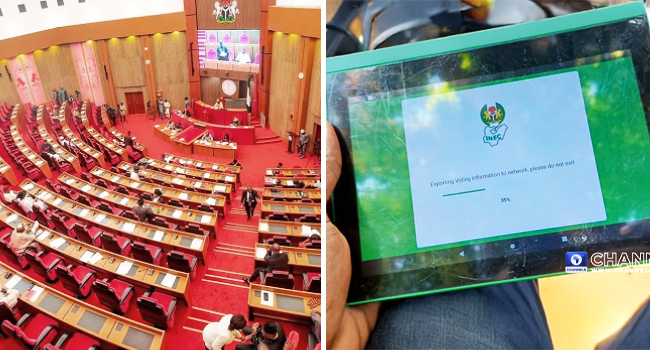
A professor of Political Economy, Pat Utomi, has called for the mass recall of National Assembly (NASS) members who did not support calls for the “real-time” transmission of election results.
Utomi made this call during an interview on Channels Television’s Sunrise Daily on Wednesday, saying the people are the ultimate authority.
“The people are the ultimate authority; they should begin to picket all members of the National Assembly who have not done the right thing in front of their homes, constituency, offices, and begin a process of recalling all of them from the National Assembly,” he said on Wednesday.
READ ALSO: Electoral Act Amendment: PDP Lawmaker Accuses Reps Leadership Of Sidelining Minority Caucus
His comment followed the recent controversies in the Senate over the ‘real-time’ transmission of election results during the passage of the Electoral Act.
On Tuesday, the House of Representatives passed the harmonised version of the Electoral Act after a rowdy session, a shouting match, and a walkout by opposition lawmakers.
When the bill passed its third reading in the House of Representatives last year, the lawmaker proposed the real-time transmission of election results to the IReV portal.
The Senate approved the electronic transmission of results in their version, omitting the phrase “real-time,” and also provided a manual backup option using Form EC8A in case of technical glitches.
However, during the plenary session, the House of Representatives retained the manual and electronic transmission of results, similar to the one passed by the Senate.
Reacting to the development, Utomi said the lawmakers had failed their constituents.
“They have abused the fundamental reason for representation, which is the fact that it is an agency function.
“They have deliberately chosen not to represent those people’s interests in order to advance a crooked intention to commit treason by preventing the will of the Nigerian people from being reflected in election scores.”