The Middle East war is pushing countries to open new supply routes and turn to domestic resources to tide over the world’s biggest energy crisis, the International Energy Agency said Thursday.
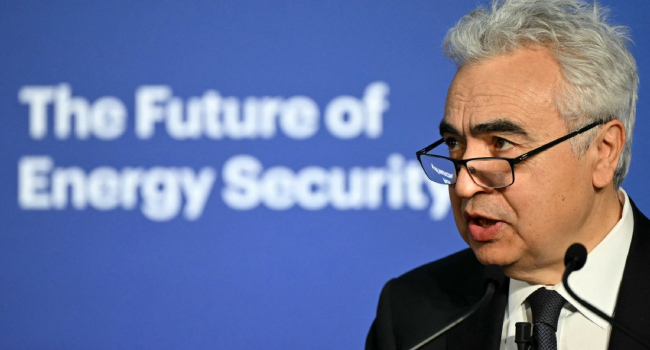
“We are in the midst of the largest energy security crisis the world has ever faced –- and I believe this will reshape investment strategies globally, with parallels to the major changes the energy world witnessed after the oil shocks of the 1970s,” said IEA executive director Fatih Birol
“We are already seeing intensified efforts by both producer and consumer countries to diversify trade routes and energy sources -– such as advancing new pipelines and other supply infrastructure, on the one hand, and turning more to domestically available resources, on the other,” he added in the World Energy Investment report by the energy agency of the Organisation for Economic Co-operation and Development (OECD).

The IEA estimates that global energy investment will reach $3.4 trillion in 2026, slightly higher than the previous year, with around $2.2 trillion devoted to power grids, storage, low-emission fuels, nuclear, renewables, energy efficiency, and electrification.
Alongside this, around $1.2 trillion is expected to be invested in oil, natural gas, and coal.

It nevertheless expects oil investment to decline for the third straight year in 2026, falling below $500 billion despite rising crude prices.
This is due to uncertainty over how long higher prices will last, project lead times, supply constraints, and the tightening offshore rigs market, which are limiting short-term investment outside the Middle East.

By contrast, investment in natural gas is “projected to rise to $330 billion, the highest level in a decade, supported by a wave of new LNG export projects, particularly in the United States and Qatar,” IEA said.
At the same time, oil-importing countries are turning to energy sources available domestically, notably renewables, nuclear, and coal, the report said.
The IEA estimates that investment in renewables should reach around $665 billion in 2026, including $365 billion for solar alone.
Investment in nuclear energy is set to exceed $80 billion annually, while investment in coal should reach $180 billion — the highest in 10 years, it said.

READ ALSO: EU To Bolster Trade Defense Tools Against China
China alone will account for nearly 70 percent of global coal supply spending, and some Asian countries may seek to extend the operation of their existing coal-fired power plants in order to strengthen their energy security.
The IEA said investment in electricity supply and infrastructure is expected to reach nearly $1.6 trillion in 2026, including around $550 billion for power grids, while investment in battery storage should exceed $100 billion.
AFP