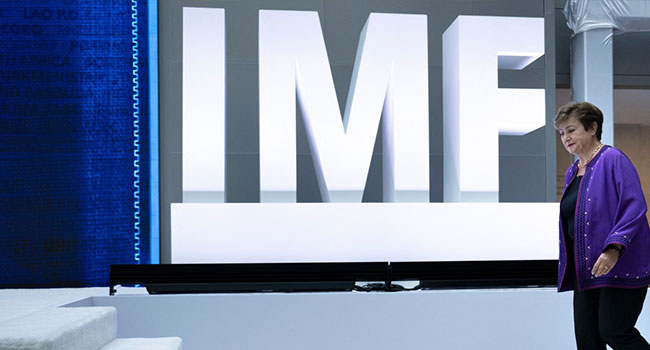
The International Monetary Fund revised up its 2025 global growth forecast on Tuesday, as tariff shocks and financial conditions have proven more benign than expected.
The Fund, however, warned that a renewed U.S.-China trade war threatened by President Donald Trump could slow output significantly.
The IMF said in its World Economic Outlook, that recent trade deals between the U.S. and some major economies have avoided the worst of Trump’s threatened tariffs with little retaliation, prompting its second growth upgrade since April.
Reuters said the IMF now predicts global real GDP growth at 3.2% for 2025, up from a July forecast of 3.0% and a more severe April forecast of 2.8% that came after Trump imposed broad global “reciprocal” tariffs, and a tit-for-tat escalation with China ensued.
It sees global growth at 3.1% in 2026, unchanged from the July forecast.
In addition to lower-than-expected tariff rates, global output has been supported by an agile private sector that front-loaded imports and quickly rerouted supply chains, a weaker dollar, fiscal stimulus in Europe and China, and an AI investment boom, said IMF chief economist Pierre-Olivier Gourinchas.
“So bottom line: not as bad as we feared, but worse than we anticipated a year ago, and worse than we need,” he said before the start of IMF and World Bank annual meetings this week.
But Trump on Friday shattered the relative calm by threatening 100% duties on Chinese goods – on top of rates averaging 55% – in retaliation for Beijing’s dramatically expanded export controls on rare earths. Treasury Secretary Scott Bessent said on Monday that talks were underway to defuse a major U.S.-China trade war escalation.
“Obviously, if this were to materialize, this would be a very significant risk for the global economy,” Gourinchas told Reuters in an interview, adding escalation could cut growth forecasts significantly and add to uncertainty that is chilling investment and spending.
READ ALSO: Asian Markets Rally As Fed Cut Hopes Trump Trade War Fears
In a downside risk scenario in the report modeling the impact of tariffs that are 30 percentage points higher than current levels on goods from China, and 10 percentage points higher for Japan, the euro area and Asian emerging markets, the IMF finds that this would cut global growth in 2026 by 0.3 percentage points with the negative impact increasing to more than 0.6 percentage points through 2028.
Adding in other potential adverse impacts, including higher inflation expectations, interest rates, and lower demand for U.S. assets, the IMF said global GDP reduction under the scenario could reach 1.2 percentage points in 2026 and 1.8 percentage points by 2027.
The IMF kept its global headline inflation forecast largely unchanged at 4.2% for 2025 and 3.7% for 2026, but said that there was divergence among countries. Inflation forecasts rose in the U.S. as firms that have held off on raising prices began to pass on tariff costs to consumers.
But the IMF said it revised inflation forecasts lower in some Asian exporting countries, including China, India, and Thailand, reflecting primarily lower growth performances.