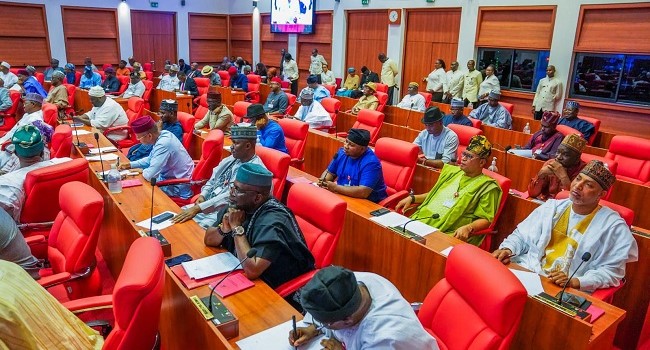
A bill seeking to create a comprehensive and harmonised regulatory framework for the operation and business of all forms of online and remote gaming beyond state and national boundaries has scaled third reading at the Senate.
It came after the presentation of the Central Gaming Bill, 2025 (HB.2062), by the Leader of the Senate, Senator Opeyemi Bamidele (Ekiti Central).
The bill for concurrence from the House of Representatives was read the third time and passed on Tuesday, awaiting transmission to President Bola Tinubu for his assent.
“A bill for the Act to repeal the National Lottery Act Number Seven of 2005 and the National Lottery Amendment Act Number Six of 2017 and to enact the Central Gaming Bill to regulate the operation and business of all forms of online and remote gaming across the geographical boundaries of the federation units and beyond the borders of Nigeria, provide for the conduct of gaming in the Federal Capital Territory and enhance revenue generation for the federation and for related matters, 2025 (HB 262) third reading taken and passed,” the Deputy Senate President, Barau Jibrin, declared.
READ ALSO: Lagos Accuses NASS Of Violating Supreme Court Ruling On Central Gaming Bill
At the House of Representatives, where the bill, sponsored by the Deputy Speaker of the House, Benjamin Kalu, and six other lawmakers, was debated, the member representing Ede Norht/Ede South/Egbedore constituency, Bamidele Salam, had said that the legislative proposal to repeal the National Lottery Act No. 7 of 2005 and the National Lottery (Amendment) Act No. 6 of 2017 and enact the Central Gaming Bill aligned with the recent decision of the Supreme Court on the conflict of jurisdiction between the federal and the state governments regarding the regulation of gaming.
He recalled that the apex court clarified that gaming, including lotteries and betting, falls within the legislative competence of states except where it relates to matters within the exclusive jurisdiction of the central government.
These, he said, included cross-border or international gaming operations.
“The Bill provides a clear legal foundation for the conduct of gaming activities within the Federal Capital Territory (FCT), where the Federal Government retains regulatory authority.
“The Bill aims to improve revenue collection from gaming activities by streamlining taxation, licensing fees, and compliance measures while ensuring transparency, accountability in revenue remittance, and promoting responsible gaming, preventing gambling addiction, and protecting consumers from fraudulent practices,” Salam explained.
By harmonising federal and state interests, the lawmaker expressed optimism that the Bill will resolve existing jurisdictional conflicts, provide regulatory certainty, and enhance investor confidence in Nigeria’s gaming industry.
Gaming Rights
Jurisdiction over online gaming has been a source of legal disagreement between the federal and state governments.
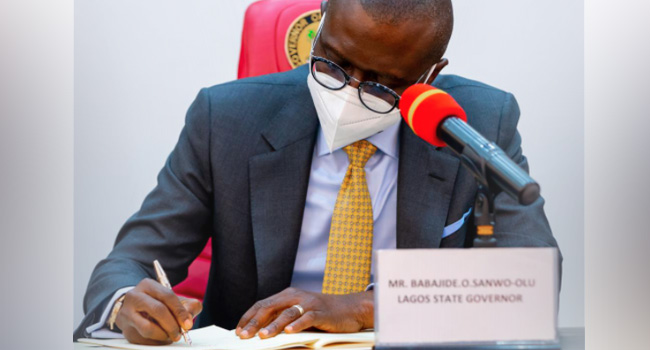
Governor Babajide Sanwo-Olu in April 2021, assented to the Lagos State Lotteries and Gaming Authority Bill of 2021, initiated by the executive arm to coordinate activities of lotteries agencies operating within the state.
But the state government, in October 2025, faulted the move by the National Assembly to repeal the National Lottery Act and replace it with the proposed Central Gaming Bill, describing it as a direct violation of the Nigerian Constitution and a subsisting judgment of the Supreme Court.
The Attorney-General and Commissioner for Justice, Lawal Pedro, SAN, warned that the Bill before the Senate, after passage by the House of Representatives, amounted to legislative overreach and a potential trigger for constitutional crisis.
Pedro explained that the Bill, which seeks to regulate all forms of online and remote gaming across the country, directly contradicted a Supreme Court judgment delivered in 2024, in a suit filed by Lagos State and 22 other states against the Attorney-General of the Federation.
“As the Chief Law Officer of Lagos State, it is both my constitutional duty and responsibility to draw the nation’s attention to the voyage of unconstitutionality embarked upon by the National Assembly to enact Act to Regulate the Operation and Business of All Forms of Online and Remote Gaming Across the Geographical Boundaries of the Federating Units and Beyond the Borders of Nigeria,” the commissioner had said.
Apex Court Ruling
In October 2024, the Supreme Court nullified the National Lottery Act 2005, enacted by the National Assembly on the grounds that it was made in violation of the powers delegated by the Constitution to the federal Legislature.
In a unanimous judgment, a seven-member panel of the apex court held that the National Assembly lacked the powers to legislate on issues relating to lottery and games of chance.
The court held that such powers only resided with the state houses of assembly, which possess exclusive jurisdiction over lottery and related issues.
In the lead judgment, Justice Mohammed Idris resolved the two issues identified for determination against the Attorney General of the Federation (AGF) and one other, listed as defendants.
He granted all the reliefs sought by the plaintiffs. The judgment was on the suit, marked: SC/1/2008 filed by Lagos and some other states.
Justice Idris ordered that the National Lottery Act 2005 should no longer apply in all states, except the Federal Capital Territory (FCT), in respect of which the National Assembly is empowered to make laws.
He also declared that lotteries or games of chance are not one of the items on the Exclusive Legislative List contained in the Constitution in respect of which the National Assembly has the powers to make laws for the whole of the country.
The judge also declared that having regard to the clear provisions of Section 4(2) & (3) of the Constitution, the National Assembly lacks the powers make any legislation for the control and regulation of lottery in Nigeria.
He equally declared that, having regard to the provisions of Section 4(4)(a) & (b) and Part 2 of the Second Schedule of the Constitution, matters relating to lottery are not issues on which the National Assembly and state Houses of Assembly have concurrent powers to make laws.
Justice Idris also declared that having regard to the provisions of section 4(7)(a) & (c) of the First Schedule to the Constitution, the House of Assembly of Lagos State and other states have the powers, to the exclusion of the National Assembly, to make laws for the regulation and control of lottery within their states.
READ ALSO: UPDATED: Supreme Court Nullifies National Lottery Act
He further declared that, having regard to the provisions of sections 4(4)(b), 7(a) and 39, 29(9)(a) of the Constitution, the power of the National Assembly to make laws for the regulation and control of lottery is limited by the Constitution.
The judge also declared that sections 17, 18, 19, 20, and 21 of the National Lottery Act 2005 made by the National Assembly are inconsistent with the Constitution, adding that the National Lottery Act is inconsistent with the provisions of the 1999 Constitution.
He proceeded to issue an order nullifying the entirety of the National Lottery Act, and also issued an order of perpetual injunction restraining the first defendant (AGF), either by himself or his agents or any other agency of the Federal Government from implementing the provisions of the National Lottery Act within the territories of the plaintiff states.
The suit was filed in 2008 by the Attorney General of Lagos State against the Federal Government in respect of who controls and regulates the gaming and lottery sector.
Ekiti State was joined as a co-plaintiff in the suit following an order of the court made on October 6, 2020.
Subsequently, attorneys general of 34 other states were joined as defendants by the Supreme Court on November 15, 2022.
The plaintiffs had asked the apex court to declare that the lottery was not one of the 68 items for which the National Assembly has the exclusive powers to make laws under Part 1 of the Second Schedule of the 1999 Constitution as amended.
They also sought a declaration that the National Assembly lacked the vires to legally and constitutionally make any law to regulate and control the operation of the lottery in Nigeria.