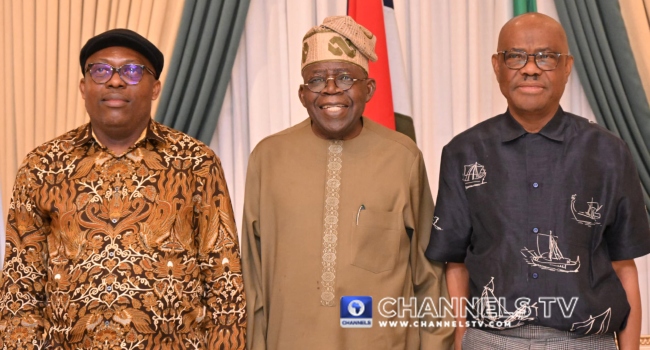
Columnist and political analyst Majeed Dahiru has described the outcome of the Rivers State political reconciliation as a rare victory for a political godfather, noting that FCT Minister, Nyesom Wike, has “triumphed” over his estranged protégé, Governor Siminalayi Fubara.
“This is a classic case of a hat-trick in football. Wike has emerged victorious. He came out on top, and Fubara has found his level. That game-changer was indeed the declaration of a state of emergency.
“It was declared—got Fubara to surrender and handed over victory in favour of Wike. So Wike has triumphed,” Dahiru said on Channels Television’s Sunday Politics.
Dahiru argued that the imposition of a state of emergency in the oil-rich state led Fubara to surrender, handing the victory squarely to Wike.
He said, “It’s a rare feat in Nigeria for a godfather to triumph over their godson they have installed as governor. I think the only other person who has recorded this feat will be President Tinubu himself when he triumphed over Ambode (ex-governor of Lagos State).”
However, he criticised the legal basis of the emergency measure.
“The state of emergency is unconstitutional. It is illegal. I wish this were managed better—without infringing on the constitution of Nigeria. By any stretch of legal opinion, a state of emergency does not entail sacking a democratically elected structure,” Dahiru stated.
READ ALSO: Rivers People Expect Fubara To Fight And Not Be Tied — Ann-Kio Briggs

The political analyst said there are no heroes in the Fubara-Wike feud and dismissed claims that Rivers people resisted godfatherism, insisting no one should take sides in a deal they weren’t part of.
“In the fight between Fubara and Wike, there are no heroes and no victims. They belong to the same political family. You can’t take sides when you’re not privy to the deal that has gone sour,” he said.
“I’m sorry to say this, but you didn’t vote for Fubara. Resources were deployed by someone to get him there. So, for every vote that was bought, it no longer belongs to you,” the analyst claimed.
Asked whether it would have been better to impeach the governor, he replied, “Politically, this is better for Fubara. But constitutionally, it would have been more appropriate to remove him via impeachment than use a state of emergency to provide a soft landing.”
Presidential-brokered Peace

The comment follows Thursday’s late-night meeting at the Presidential Villa, Abuja, where President Bola Tinubu, Wike, Fubara, and some members of the Rivers Assembly agreed to a truce.
“We have all agreed to work together with the governor, and the governor has also agreed to work with all of us. We are members of the same political family. We all have disagreements, but they’ve been resolved,” Wike said after the meeting.

Fubara, who had been suspended from office along with his deputy and the House of Assembly earlier in March, also addressed supporters in Port Harcourt on Saturday.
“There is no sacrifice too big for peace. Every decision, including reconciliation with my predecessor, was made in your collective interest,” he said.
The governor admitted the deal had disappointed some loyalists but insisted it was necessary for the stability of the state.
“These decisions were not taken alone. There were consultations with stakeholders within the political family,” he explained.
Earlier in March, President Tinubu suspended Fubara and declared a state of emergency in the state, citing security breaches, including pipeline explosions and prolonged political instability.
He appointed retired naval chief Ibok-Ete Ibas to oversee governance temporarily, invoking Section 305 of the Constitution.

The move sparked nationwide backlash, with opposition leaders and civil society groups condemning the suspension of a democratically elected governor.
Despite the criticism, Tinubu maintained that the action was in the best interest of Rivers and the nation.
Signs of reconciliation deepened over the weekend, with Wike, Fubara, and the suspended Speaker, Martin Amaewhule, attending a funeral together in Wike’s hometown—marking their first public appearance since the truce.