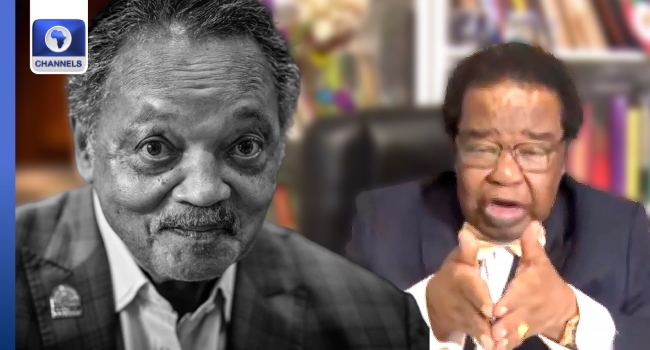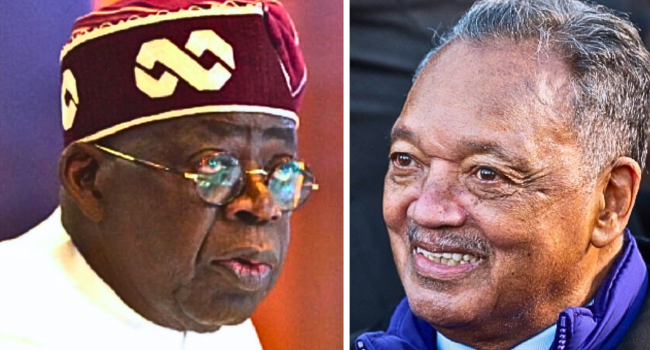
President Bola Tinubu has sent a five-person delegation to represent him and Nigeria at the final burial rites of Reverend Jesse Jackson, the American civil rights leader, activist and former presidential candidate.
Jackson died at age 84 on February 17, 2026, in Chicago.
According to a statement by presidential spokesperson Bayo Onanuga, the delegation will be led by Senator George Akume, Secretary to the Government of the Federation.
Other members are the Minister of State for Foreign Affairs, Bianca Odumegwu-Ojukwu; the Minister of Arts, Culture and Creative Economy, Hannatu Musawa; the Special Presidential Envoy for Global and Pan-African Affairs, Brian Browne; and the Senior Special Assistant on Foreign Affairs and International Relations, Ambassador Sola Enikanolaye.
READ ALSO: How Jesse Jackson Was Part Of June 12 Struggle – Bolaji Akinyemi
Onanuga said the delegation would deliver President Tinubu’s message of condolences to the Jackson family.
In an earlier tribute, Tinubu described Jackson as a great friend of Nigeria and Africa.
“He was a moral voice and a formidable opponent of apartheid in South Africa. He played a leading role in the campaign for the release from prison of Nelson Mandela and other African National Congress leaders. He won critical support for sanctions against the then apartheid government,” the president wrote.
The burial programme began on February 26 with a lying-in-state at the Rainbow PUSH Coalition in Chicago. Services in South Carolina and Washington, D.C., and a lying-in-state at the South Carolina Statehouse were scheduled for March 1–5.
On March 6, a “People’s Celebration” will take place at House of Hope in Chicago, followed by a private homegoing on March 7 at the Rainbow PUSH Coalition.
The veteran political activist and one of America’s most influential Black voices died on February 17.
His family said he died peacefully. They did not release a cause of death, but Jackson revealed in 2017 that he had the degenerative neurological disease Parkinson’s. He was hospitalised in November in connection with another neurodegenerative condition, according to media reports.
The activist was a dynamic orator and a successful mediator in international disputes. The long-time Baptist minister expanded the space for African Americans on the national stage for more than six decades.
He was present for many consequential moments in the long battle for racial justice in the United States, including with King in Memphis in 1968 when the civil rights leader was slain.
The activist openly wept in the crowd as Barack Obama celebrated his 2008 presidential election, and he stood with George Floyd’s family in 2021 after a court convicted a police officer of the unarmed Black man’s murder during an arrest.
Jackson was born Jesse Louis Burns on October 8, 1941, in Greenville, South Carolina, to an unwed teen mother and a former professional boxer.
He later adopted the last name of his stepfather, Charles Jackson.
“I was not born with a silver spoon in my mouth. I had a shovel programmed for my hands,” he once said.
He excelled in his segregated high school and earned a football scholarship to the University of Illinois, but later transferred to the predominantly Black Agricultural and Technical College of North Carolina, where he received a degree in sociology.
In 1960, he participated in his first sit-in in Greenville and then joined the Selma-to-Montgomery civil rights marches in 1965, where he caught King’s attention.
Jackson later emerged as a mediator and envoy on several notable international fronts.
He became a prominent advocate for ending apartheid in South Africa and, in the 1990s, served as presidential special envoy for Africa for Bill Clinton.
Missions to free US prisoners took him to Syria, Iraq, and Serbia.
He founded the Rainbow PUSH Coalition, a Chicago-based non-profit organisation focused on social justice and political activism, in 1996.
He is survived by his wife and six children.