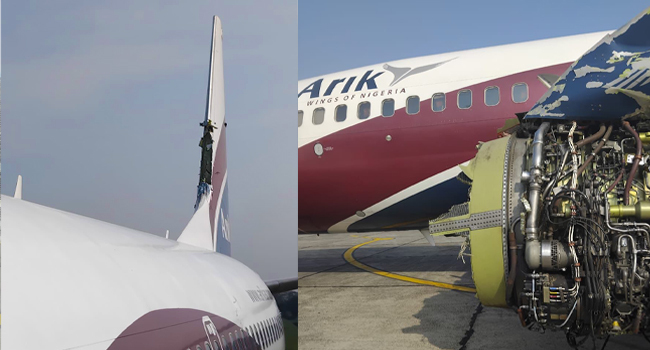
The Nigerian Safety Investigation Bureau (NSIB) has released a preliminary report on a serious in-flight engine failure involving an Arik Air Boeing 737-700 (registration 5N-MJF) that occurred on February 11, 2026.
The aircraft, operating Flight ARA740 from Lagos (DNMM) to Port Harcourt (DNPO), departed Lagos at 07:24 h with 87 people on board, including seven crew members and 80 passengers.
At 07:35h, while climbing through flight level 260, the crew reported a loud bang followed by severe vibrations and grinding noises from the No. 1 (left) engine.
The pilots immediately declared a MAYDAY, shut down the affected engine, and diverted the flight to Benin City Airport (DNBE), landing safely at 08:06:07 h. All passengers and crew disembarked without injuries.
READ ALSO: Arik Air Flight Diverts Safely To Benin After In-Flight Engine Anomaly – NSIB
Initial signs of trouble had been noted shortly after take-off when the cabin crew reported a “hissing sound” from the L1 door, initially attributed to a door seal.
Post-incident inspections revealed significant engine damage: One fan blade was missing at the root; the remaining 23 blades were chipped or damaged, the engine inlet cowling was missing, deep cuts and cracks were identified in the engine containment case, and the airframe also sustained damage, including dents and punctures to the left wing, horizontal stabiliser, and rudder.
The NSIB confirmed that the crew were properly licensed and tested negative for alcohol and drugs.
It said the aircraft held a valid Certificate of Airworthiness. Maintenance records indicate that a repetitive ultrasonic inspection of the fan blades was conducted in March 2025, with no defects found at that time.
According to the NSIB’s preliminary report, Engine Damage: Structural failure of one fan blade, with additional chipping of remaining blades. Structural Impact: At least 23 aircraft components were affected. Crew Compliance: Pilots were fully compliant with regulations. Maintenance History: No defects had been identified during prior inspections
The NSIB is continuing its investigation to determine whether the engine failure was caused by mechanical fatigue, foreign object debris (FOD), or a bird strike, including metallurgical analysis of the damaged fan blades and a full teardown of the No. 1 engine.