Before the first heavy drops strike roofs and floodplains begin to swell, Nigeria has begun urging millions to act before water turns from a life source to a looming threat. As clouds gather on the horizon, the annual warning is this time louder, sharper, and more urgent, as the Federal Government is turning data into a call for preparedness.
READ ALSO: Lagos Predicts Above-Normal Rainfall For 2026, Issues Flood Alert To Residents
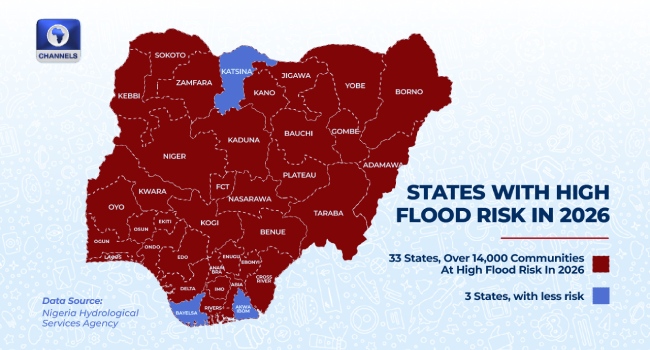
At the public presentation of the 2026 Annual Flood Outlook by the Nigeria Hydrological Services Agency at the State Banquet Hall of the Aso Villa, Abuja, the Minister of Water Resources and Sanitation, Joseph Utsev, revealed that 226 local government areas in 33 states of the federation and the Federal Capital Territory (FCT) fall within the high flood risk areas identified in 2026.
“Fourteen thousand, one hundred and eighteen communities in 266 local government areas in 33 States and the FCT fall within the high flood risk areas.
“The states are: Abia, Adamawa, Anambra, Bauchi, Bayelsa, Benue, Borno, Cross River, Delta, Ebonyi, Edo, Enugu, Gombe, Imo, Jigawa, Kaduna, Kano, Kebbi, Kogi, Kwara, Lagos, Nasarawa, Niger, Ogun, Ondo, Osun, Oyo, Plateau, Rivers, Sokoto, Taraba, Yobe, Zamfara, and the FCT,” Utshev, a professor, said on Wednesday.
According to the outlook, 405 LGAs in 35 states of the federation fall within the moderate flood risk area, except Ekiti State.
Low-Risk Zones, New Forecasting Tools
Meanwhile, incidents of minimal flood are expected in 923 communities in 77 LGAs in 24 states.
“Low Flood Risk: Incidences of minimal flood are expected in 923 communities in 77 LGAs in 24 States. The states are Adamawa, Anambra, Bauchi, Bayelsa, Benue, Borno, Cross River, Delta, Ebonyi, Edo, Jigawa, Kaduna, Kano, Kebbi, Kogi, Nasarawa, Niger, Ogun, Ondo, Osun, Oyo, Sokoto, Taraba, and Zamfara,” the minister said.
He further disclosed that this year’s annual flood outlook introduced a community-based flood forecasting, which means forecasts are now tailored to specific communities for quick intervention.
Flash Flood
The Lagos State Government had projected that the 2026 rainy season would begin as early as the last week of March and end in the first week of December, with an average annual rainfall ranging between 1650mm and 3030mm. Commissioner for Environment and Water Resources, Tokunbo Wahab, warned that the pattern could result in flash flooding, strong winds, and risks to lives and property, particularly in low-lying areas.
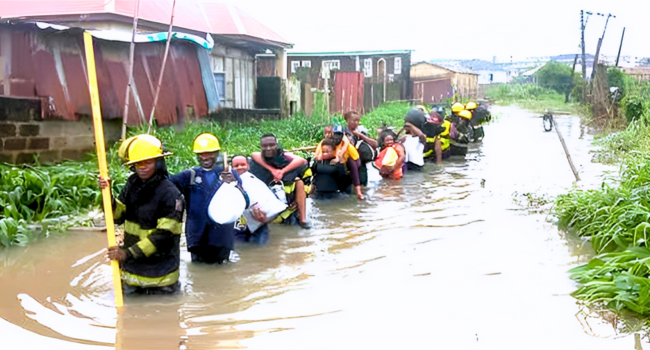
He noted that while flash floods may occur, they often recede quickly, adding, “It is only when a flash flood remains on the roads for hours that we can report that a place is flooded. I, therefore, wish to plead with the media to avoid sensational headlines that create panic.”
He also explained that rising lagoon levels and tidal movements could temporarily block drainage discharge, causing backflows and flooding until water levels subside.
To mitigate risks, the government said it had strengthened monitoring systems and emergency preparedness, including drainage maintenance, weather stations, and collaboration with the Ogun-Oshun River Basin Authority.
“To ensure a flood-free and hygienic environment in the state, the Ministry is continuing with its all-year-round drainage maintenance programme,” Wahab stated, adding that authorities would sustain efforts to control water releases from Oyan Dam.
Residents in flood-prone communities were advised to remain alert and relocate when necessary, while agencies have been placed on high alert to manage the anticipated impacts of the season.
2025 Outlook
Similar early warning systems had been issued by the Nigerian Meteorological Agency, which consistently alerts Nigerians ahead of the rainy season about potential flooding, extreme weather patterns, and the need for early preparedness.
The 2025 Annual Flood Outlook had earlier warned of widespread flooding across several states, reinforcing the pattern of recurring seasonal risks and the urgency of proactive response.
In August 2025, the Nigeria Hydrological Services Agency (NIHSA) warned of flooding in certain parts of the country, including Lagos, Rivers, the FCT, and 28 other states.
The NIHSA said the alert followed rising river levels and persistent rainfall across the country.
Its Director General, Umar Ibrahim, cautioned of high to very high flood risks between August 7 and August 21.
The affected states include Adamawa, Akwa Ibom, Anambra, Bauchi, Bayelsa, Benue, Borno, Cross River, Delta, Ebonyi, Edo, FCT, Gombe, Imo, Jigawa, Kaduna, Kebbi, Kogi, Kwara, Lagos, and Nasarawa.
Others were Niger, Ogun, Ondo, Plateau, Rivers, Sokoto, Taraba, Yobe, and Zamfara.

A total of 198 LGAs and 832 communities fell within the projected flood impact zone, NiHSA said
“Possible disruption of major transportation routes is anticipated,” NIHSA stated, citing data from its colour-coded flood risk map.
It also encouraged residents and stakeholders to follow its weekly state-level and community-specific forecasts and to stay informed via the NIHSA flood dashboard and official social media platforms.
In the same year, state governments, including the national commercial nerve, Lagos, advised residents in flood-prone areas to move to higher ground.
The Lagos State Government issued a warning to residents in parts of Lekki, Ikorodu, and Ajegunle areas of the state to relocate from lowlands to highlands to avoid being victims of flooding.
It said that Lagos, being a coastal city, was exposed to the vagaries of climate change and would experience flash flooding this year.
“Those around the Ajilete axis of Lagos, that’s Ajegunle, they have to move. Those around the coastline of Ikorodu, Majidu, have to move. Some areas around the Lekki corridor, too, not all,” Commissioner for Environment Tokunbo Wahab said on Channels Television’s Politics Today, urging residents of Isheri in the OPIC area of the state to also be on alert.
Among other factors, Nigeria, like other countries, has continued to experience the impact of climate change, as experts advocate the adoption of tree planting and the reduction in the use of plastics that clog draining systems, causing flooding, endanger aquatic life.
Government Push
Meanwhile, President Bola Tinubu has reaffirmed his administration’s commitment to strengthening emergency response systems and promoting sustainable development across the country.

Tinubu, who was represented by the Minister of Environment, Balarabe Lawal, said that the government had carefully assessed existing challenges and recognised the critical role of rescue teams in mitigating emergencies.
He noted that efforts were underway to enhance the capacity and strategic direction of relevant ministries to ensure more effective and timely responses.
The President also stressed the need to build a sustainable future through improved coordination, planning, and service delivery.
According to him, effective communication remains a key tool in fostering collaboration, increasing public awareness, and ensuring prompt response to emerging issues.
Tinubu said that with improved communication and strategic planning, the government was confident of overcoming current challenges and delivering better outcomes for citizens.
The 2026 Annual Flood Outlook, themed ‘Smart Water Resources Management: Moving From Oil To A Water-Based Economy,’ also had in attendance ministers and other stakeholders, signalling a shift in how Nigeria views its water resources—not just as a risk, but as an economic and environmental asset.