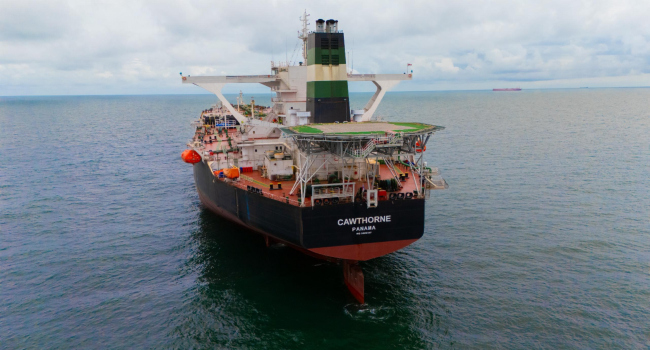
Nigeria’s revenue outlook is set for a boost following the introduction and lifting of 950,000 barrels of Cawthorne Blend crude into the global market, marking a significant milestone in the country’s upstream oil sector.
The milestone was achieved via the FSO Cawthorne vessel, described as Nigeria’s first new crude oil terminal in 50 years.
According to a statement by the Sahara Group, the development marks a significant step in strengthening the country’s upstream capacity.
“Over the weekend, the first shipment of 950,000 barrels from FSO Cawthorne, Nigeria’s newest oil terminal, was initiated following its licensing and gazetting by the Nigerian Upstream Petroleum Regulatory Commission (NUPRC),” the statement read in part.
The new crude, comparable in quality to Nigeria’s widely traded Bonny Light, is expected to attract strong demand from global refiners due to its high gasoline and diesel yield.

Infrastructure Driving Growth
At the centre of this development is the Nigerian National Petroleum Company Limited, led by Bayo Ojulari, whose push for increased production aligns with broader national goals of boosting output and revenue.
The FSO Cawthorne serves as a critical offshore asset, enabling storage and export operations from Oil Mining Lease (OML) 18 and nearby fields. Sahara Group, a joint venture partner in the asset, highlighted the facility’s advanced capabilities, including artificial intelligence-enabled monitoring and strong safety systems.
Reacting to the milestone, Head of Commercial and Planning at Asharami Energy, Tosin Etomi, described the development as transformative.
“The successful commencement of crude lifting from FSO Cawthorne is a significant milestone for the OML 18 partnership and a strong demonstration of what can be achieved through shared vision, technical discipline, and committed collaboration,” Etomi said.
He added that the transition into active export aligns with a broader strategy focused on “operational excellence, indigenous participation and infrastructure capable of sustainably supporting Nigeria’s production ambitions.”
Industry Collaboration
The project underscores the role of collaboration across Nigeria’s energy ecosystem.
Etomi commended key institutions, including the Nigerian Upstream Petroleum Regulatory Commission, Nigerian Ports Authority, Nigeria Customs Service, and the Nigerian Midstream and Downstream Petroleum Regulatory Authority, for ensuring seamless operations.
“Our expanding oilfield services capabilities are integral to our upstream vision, enabling smarter operations, improved efficiencies, and responsible resource development,” Etomi said.
READ ALSO: Nigeria’s Oil & Gas Sector Records $17.98m Capital Inflows In 2025
He further emphasised that sustainability and community engagement remain central to operations.
“Sustainable social impact interventions and community participation have been key drivers of our upstream success, and we remain committed to aligning our operations with the highest global environmental, social, and governance standards,” Asharami Energy’s spokesperson added.
Push For Higher Output
The launch of Cawthorne Blend comes amid renewed efforts to scale Nigeria’s oil production.
Authorities have intensified measures to curb oil theft, improve pipeline security, and attract investment into the upstream sector — long-standing challenges that have constrained output.
The Federal Government is targeting higher production benchmarks within the Organisation of the Petroleum Exporting Countries (OPEC), leveraging improved output levels and new infrastructure to strengthen its position.
For global energy markets, Nigeria’s new crude grade may offer an additional supply stream of high-quality light sweet oil — a category prized for its efficiency in refining.