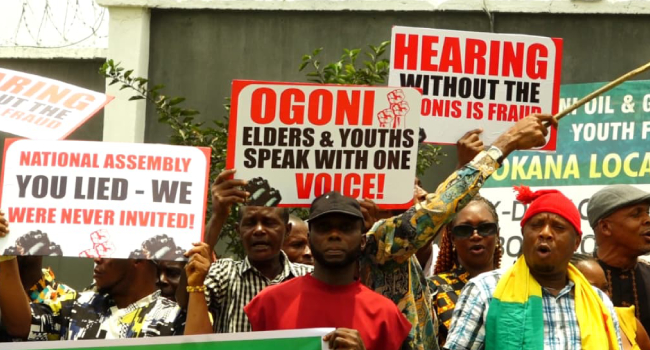
Concerns over pipeline surveillance in Rivers State are deepening, as youth groups have protested alleged exclusion from a National Assembly round table on the matter.
The Ijaw Youth Council (IYC), National Youth Council of Ogoni People (NYCOP), Ogoni Host Communities Youth Associations, and other groups said they were not invited to the National Assembly roundtable on pipeline surveillance and crude oil theft, contrary to claims by lawmakers.
The groups staged a peaceful protest in the Gokana Local Government Area of Rivers State, marching through communities with placards to express dissatisfaction over what they described as exclusion from critical discussions affecting their region, while insisting on the decentralisation of pipeline surveillance.
Leading the protest, President of the Ijaw Youth Council, Alaye Theophilus, said the groups were not allowed to present their case.
“We were not invited to appear before the National Assembly to defend our petition, despite claims by the committees,” he said.
READ ALSO: Rivers Monarchs Reject Pipeline Surveillance Decentralisation, Back Existing Framework

He also called on the Presidency and the Office of the National Security Adviser to act swiftly, adding that “the Federal Government, as a matter of urgency, should decentralise the pipeline surveillance contract so that each state can manage its own, in the interest of equity and fairness.”
Also speaking, the president of the National Youth Council of Ogoni People, Marcus Nwibani, said the agitation is driven by the need for inclusion and recognition of host communities.
“We are not here for publicity; we are here because the Niger Delta is critical to this country,” he said.
“What belongs to the people must be given to the people,” Nwibani said, adding that Ogoni must not be excluded from engagements on oil exploration and pipeline surveillance.
Nwibani further noted that the region has capable hands to manage its resources, saying inclusion of local communities would promote peace and accountability.
On his part, the President of the Ogoni Youths Federation, Emmanuel Bie, said oil-bearing communities in Ogoni have remained spectators despite decades of oil exploration.
“Since oil was discovered in Ogoni in 1958, our people have remained spectators in decisions affecting our resources,” he said.
He added that “this community has over forty oil wells, yet no indigenous person has been given contracts to secure these facilities”, stressing that such responsibilities should be given to the Ogoni people.
Bie also called for reforms, stating that decentralising pipeline surveillance contracts would improve monitoring and help curb crude oil theft.
The youth leaders insisted that involving host communities in pipeline surveillance will not only promote inclusion but also strengthen security and ensure sustainable peace in the Niger Delta.
Meanwhile, traditional rulers have backed the current pipeline surveillance structure in the Niger Delta.
During a briefing in Port Harcourt, they called on the federal government to resist moves to decentralise it.
At the centre of the talks is the surveillance framework handled by Tantita Security Services Nigeria Limited.