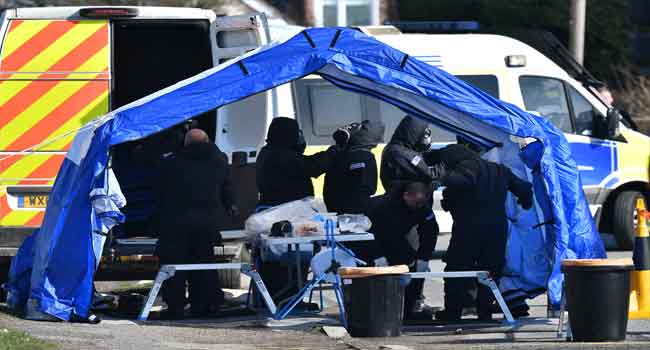
Blood samples from former Russian spy Sergei Skripal and his daughter Yulia can be taken for testing by the OPCW world chemical weapons body, an English judge ruled Thursday.
The Skripals, victims of a nerve agent attack that Britain has blamed on Russia, are in a coma in a critical but stable condition in hospital in Salisbury, southwest England.
Britain has called in the OPCW, the Organisation for the Prohibition of Chemical Weapons, to verify their findings that the nerve agent was one developed by the Soviet Union and held by Russia.
Moscow denies all responsibility for the March 4 attack and the poisoning has plunged relations between Britain and Russia into a severe crisis.
Judge David Williams ruled it was lawful for doctors “to take blood samples for provision to OPCW and to provide copies of medical notes to OPCW”.
The High Court judge concluded that it was in the best interests of the Skripals, who are unconscious and therefore unable to give their consent.
He made the ruling following a private hearing earlier this week in the Court of Protection in London, where issues relating to people who lack the mental capacity to make decisions are considered.
The balance of judgement “falls very clearly in favour of the taking of the samples, their submission for analysis by OPCW and the disclosure of the medical notes to aid that process,” Williams said.
“In so far as it is necessary it is also lawful and in their best interests that the existing samples are provided to OPCW for further testing.”
Details on health, OPCW probe
The ruling, published online by the English judiciary, went into greater details about the Skripals’ state of health, what the OPCW want to do and the evidence British officials put before the court.
“Both Mr and Ms Skripal remain in hospital under heavy sedation,” Williams said.
“The precise effect of their exposure on their long-term health remains unclear albeit medical tests indicate that their mental capacity might be compromised to an unknown and so far unascertained degree.
“It is not inconceivable that their condition could rapidly deteriorate,” he added.
“On the evidence currently available, it is not possible to say whether the current lack of capacity”, to give consent, “is temporary or permanent”.
The ruling said it was the OPCW’s wish to collect fresh blood samples, undertake their own analysis in relation to evidence of nerve agents, and conduct DNA analysis to confirm the samples originally tested in Britain’s defence laboratories as being from the Skripals.
They also want to analyse their medical records and re-test the samples already analysed by the British labs.
The OPCW probe is “likely to produce the most robust, objective, independent and reliable material which will inform any determination of what happened.
“That might simply confirm the current conclusions, it might elaborate or clarify them, it might reach a different conclusion,” the judge said.
Blood already analysed
Williams summarised witness evidence put before him, but ruled that their names could not be published.
The judge said a chemical and biological analyst from Britain’s Porton Down military laboratory had told the court they had analysed blood samples from the Skripals.
“The findings indicated exposure to a nerve agent or related compound. The samples tested positive for the presence of a Novichok class nerve agent or closely related agent,” the judge summarised.
A representative from the Foreign Office Arms Control told the court that Britain requested assistance from the OPCW to obtain independent, internationally recognised expert identification of the nerve agent used.
“Their report… will be of real importance for many reasons including in relation to the ongoing criminal process, detecting and deterring any further attacks, allaying false rumour and in supporting the international response,” the judge said.
Furthermore, “If the OPCW results differ from UK tests the UK national authority will be able to share them with clinicians to inform medical treatment.”
A treating consultant told the hearings that Skripal, 66, was unable to communicate at all, while his daughter, 33, could not communicate in any meaningful way.
Their condition is not expected to change in the immediate or near future.
They are both being treated on the basis that they would wish to be kept alive and to achieve optimal recovery, the consultant told the court.
AFP