A Professor of Strategic Management and Human Capital Development, Okey Ikechukwu, has faulted the deployment of the military in roles that the police should play.
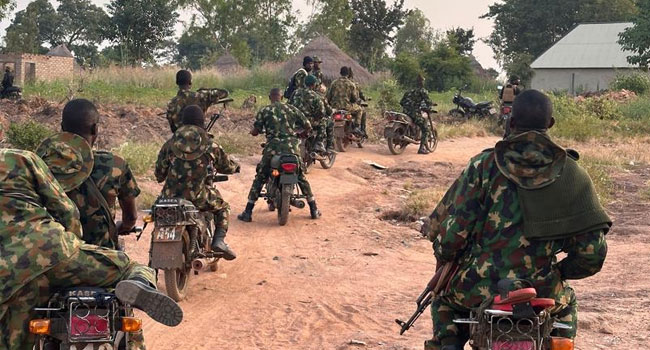
Ikechukwu said operatives of the Nigerian military have been overstretched as a result of their involvement in tackling the nation’s security challenges.
“We are overstretching the Nigerian Army completely; they have no business on the road,” Ikechukwu spoke on Tuesday during Channels Television’s end-of-year show, “2025 in Retrospect: Charting a Pathway to 2026.”
“They are trained to deal with defined targets. Today, the targets are embedded in the communities. I am going to say a place like Mushin to get rid of bandits.
“The bandits have buried themselves within the community. By my training, I shoot definite targets; there is no target to shoot. In addition, my boys, who should be in the barracks or elsewhere, many of them are on the road.”
READ ALSO: Troops Rescue Abductee, Recover Rustled Cattle In Kano
The professor also stressed the need for intelligence, arguing that proper intelligence could avert attacks by non-state actors.
He explained that local communities should provide the military with proper information that would be processed as intelligence by the authorities to tackle non-state actors.
Decrying the spate of attacks in several parts of the country, Ikechukwu called for more funding for the nation’s security forces.
Making a case for an increased budgetary allocation for the defence sector, Ikechukwu stated that the market value of 10 Mine-Resistant Ambush Protected (MRAP) vehicles is about one trillion naira.
Nigeria suffers from multiple interlinked security concerns, from jihadists in the northeast to armed “bandit” gangs in the northwest.
A wave of attacks in November saw some 400 people kidnapped, including more than 300 schoolchildren in two assaults, according to an AFP tally of major incidents. But they were later rescued.
In the 12 months between July last year and June 2025, at least 4,722 people were kidnapped in 997 incidents, and at least 762 were killed, according to a recent report by SBM Intelligence.
During that period, “Nigeria’s kidnap-for-ransom crisis consolidated into a structured, profit-seeking industry,” said the Lagos-based security advisory firm.
It said kidnappers obtained some 2.57 billion naira (around $1.66 million) in ransom.
Motivated by money rather than ideology, bandits conduct kidnappings, extortion, and looting in areas that have long suffered from little state or security presence. Government efforts have tried to strike peace deals with bandits.
Critics say that while such accords have occasionally brought relief, they often result in the bandits keeping their arms and using areas where they have a truce as a base to attack neighbouring localities.