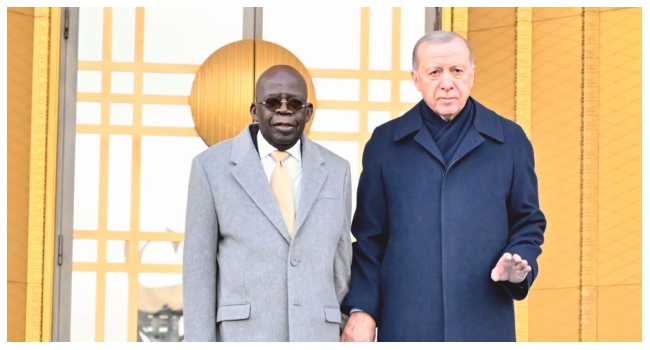
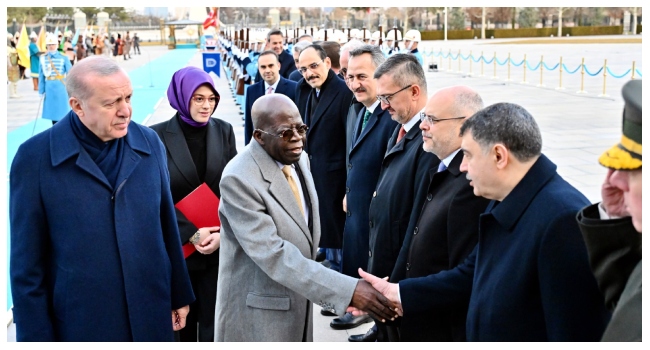
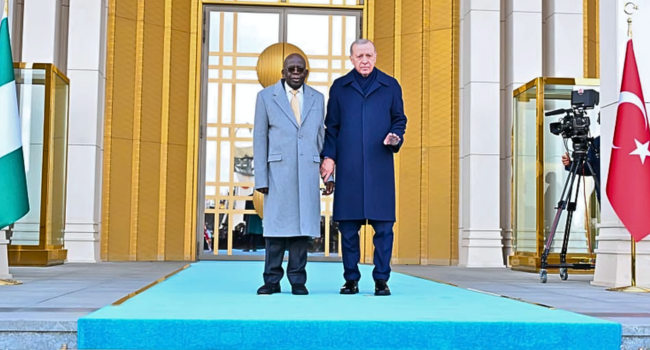
When President Bola Tinubu stepped onto the tarmac in Ankara, the Turkish capital, he wasn’t just on a routine state visit.
In the chilly Turkish winter, Tinubu’s mission was clear: to strengthen a partnership that could provide the technology to secure Nigeria’s borders and the investment to jumpstart its economy.
The trip was part of a broader strategy to woo investors and “sell” Nigeria to the world. Tinubu’s visit to Turkey, which began on Monday, January 26, was one defined by action, symbolic and targeted at addressing some of Nigeria’s challenges.
A $5 billion Target
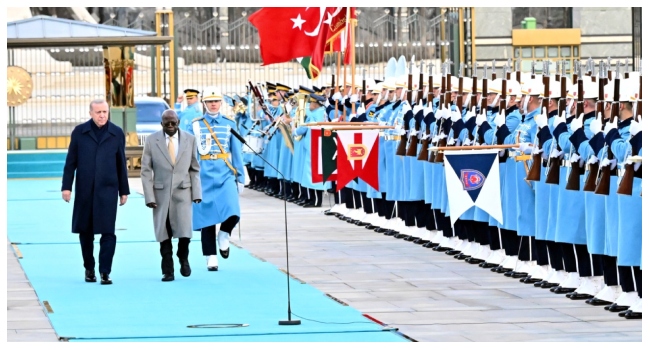
During the days’-long trip, Tinubu and his Turkish counterpart Recep Erdogan signed nine Memoranda of Understanding (MoUs). At the centre of this was the move to ramp up bilateral trade from $2 billion to $5 billion.
“We also discussed opportunities to support our investments in Nigeria. We believe that the joint Economy and Trade Committee, which we agreed to establish today, will be instrumental in this regard,” Tinubu said in a joint briefing with Erdogan.
While Nigeria exports crude oil and agricultural products to Turkiye, the European country exports planes, iron and steel, chemical products, and helicopters to the West African country.
Other deals sealed during the trip ranged from energy cooperation, media, higher education and Halal Quality Infrastructure aimed at giving Nigerian agricultural products a competitive edge.
The 71-year-old president said, “What is very important to the countries is being discussed, trade, business, no restrictions, giving opportunity to those who are ready to learn to work and prosper.
“How do we build an inclusive economy together? How do we reform the economy and involve vulnerable people? How do we ensure peace in the world?”
The deals are seen in some quarters as a direct response to the growing consensus that Nigeria’s economic reforms must begin to bear fruits, thus requiring more investments.
The Davos Mandate
At the recently-concluded World Economic Forum (WEF) in Davos, Switzerland, the Director-General of the World Trade Organisation (WTO) was clear in her call on Nigeria: the country must now “aggressively target” global investors.
“What I would like to see is a continued effort to attract investment into the country, because there is an opportunity now to attract these supply chains.
“If there is one thing I would say, it is that everything we can do to showcase Nigeria as a country worthy of investment is what we should be doing,” Ngozi Okonjo-Iweala said during a panel session titled, ‘From Scale to Capital: Financing Nigeria’s Role as Africa’s Digital Trade and Infrastructure Anchor’
“And we should deliberately have strategies to go after those investments and investors—to go to China, the US, whatever it takes—to come and invest in our country,” she added.
By taking the pitch to Turkey, President Tinubu believes that long-standing relationship with Erdogan’s country can be the engine to turn Nigeria’s economic growth into prosperity for the teeming population.
‘Ankara Pivot’
Though the trade talks and deals dominated headlines, security was part of the agenda. Much as finance was on the table, the Ankara trip was also about firepower.
With Nigeria locked in a myriad of security challenges, a partnership with Turkiye was expected to help the West African country address these issues. Tinubu and Erdogan, signed a Protocol on Military Cooperation, an agreement that symbolises more than equipment sales. Under the deal, Nigeria and Turkey will share intelligence and enjoy specialised military training.
Erdoğan was clear in his support for Nigeria’s fight against insecurity, saying: “We stand by the friendly people of Nigeria in their fight against terrorism.
“Today, we addressed opportunities for closer cooperation in military training and intelligence.”
The Turkish president, fully aware of the threats terrorist organisations pose to Nigeria, said there are “opportunities for closer cooperation in the fields of military training and intelligence”.
With Nigeria increasingly leaning to Turkish-made Bayraktar drones and anti-drone systems to secure its spaces, the visit signals a shift in the fight against insecurity.
While the trip may have raised eyebrows about Tinubu’s frequent foreign travels, what remains a question in the mouths of many is whether these Turkish deals will spark economic growth, result in food on the table and translate into peace for Nigeria.