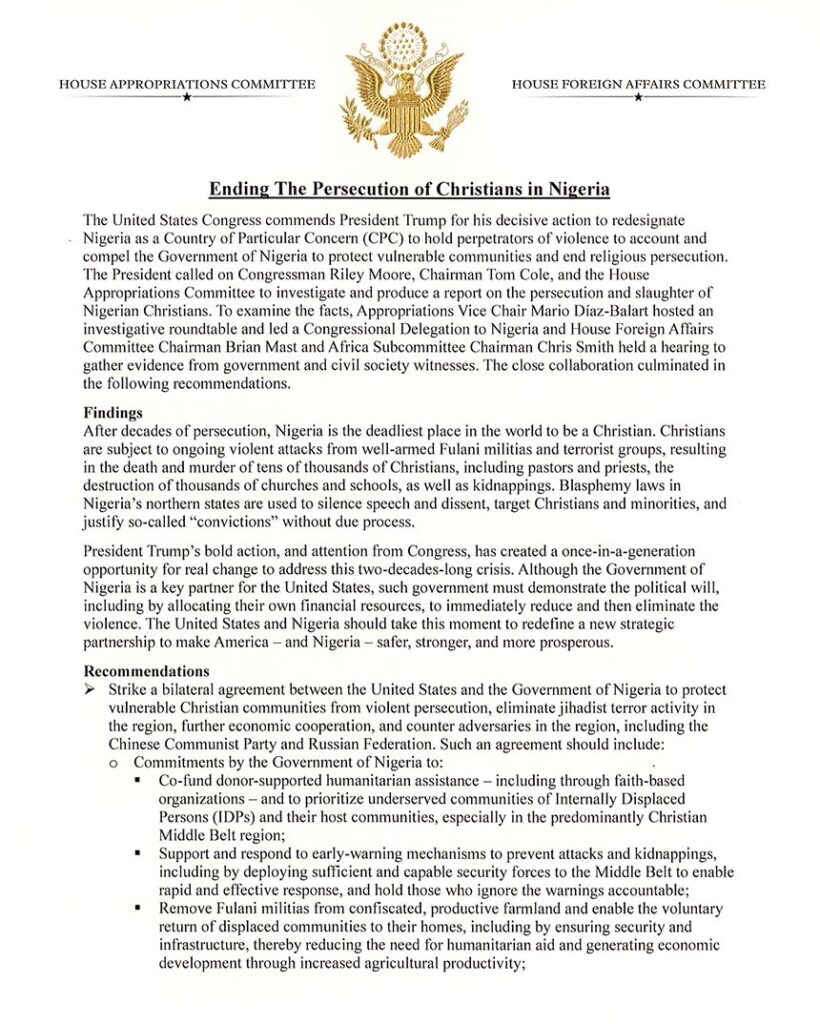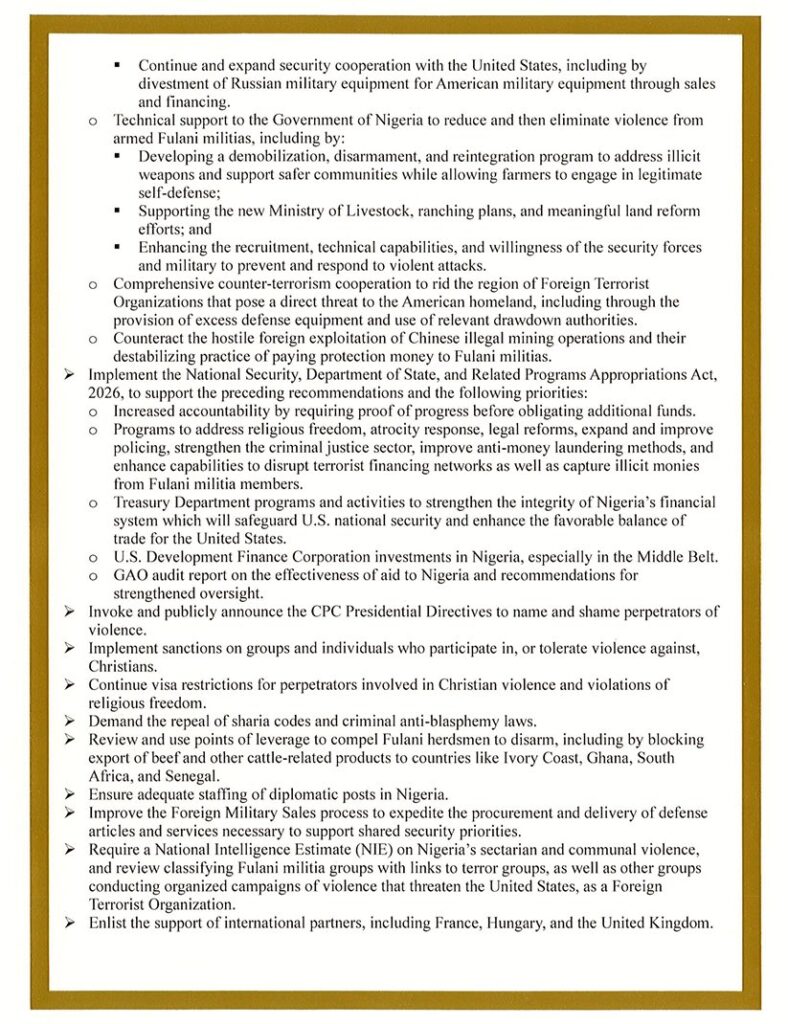
The United States House Committees on Appropriations and Foreign Affairs on Monday formally submitted a report to the White House outlining their findings and recommendations on the alleged persecution of Christians in Nigeria.
The submission follows President Donald Trump’s decision to redesignate Nigeria as a Country of Particular Concern.
The president subsequently directed Congressman Riley Moore and Chairman of the House Appropriations Committee, Tom Cole, to lead a comprehensive investigation into the reported persecution of Christian communities by terrorists, as well as the broader security challenges confronting Nigeria.
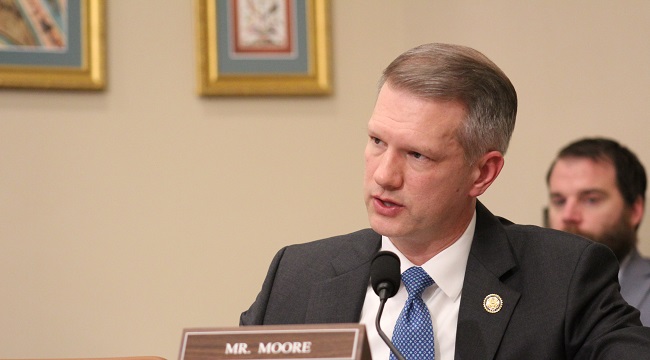
Moore confirmed the presentation of the report in a post on his X handle, @RepRileyMoore, on Monday evening.
READ ALSO: A Destabilized Nigeria Will Embolden Terrorists, Make Christians Less Safe – Riley Moore
As part of the inquiry, Moore led a bipartisan congressional delegation on a fact-finding visit to Nigeria. The delegation visited Internally Displaced Persons camps in Benue State, met with victims of terrorism, and held discussions with Nigerian government officials led by the National Security Adviser, Nuhu Ribadu.
According to Moore, the report’s conclusions were drawn from months of investigation, including interviews with expert witnesses, a hearing and roundtable session, two on-the-ground assessments conducted by bipartisan congressional delegations to Nigeria, consultations with religious leaders, meetings with Internally Displaced Persons, and close collaboration with the Trump administration.
“Today, Congressman Riley M. Moore joined members of the House Committees on Appropriations and Foreign Affairs at the White House to formally present the comprehensive report outlining concrete actions to end the persecution of Christians in Nigeria and counter growing extremist violence in the region,” Moore said.
“This report is the result of months of investigation, including a bipartisan congressional fact-finding trip to Nigeria, hearings with expert witnesses, consultations with religious leaders, meetings with Internally Displaced Persons, and engagement with senior Nigerian government officials,” he added.
Moore stated that the US team now has what he described as a clear understanding of the security threats in Nigeria and the alleged persecution faced by Christians. He urged the Nigerian government to seize the opportunity to deepen and strengthen its relationship with the United States.
The report outlines several recommendations, including the establishment of a bilateral US–Nigeria security agreement aimed at protecting vulnerable Christian communities and dismantling jihadist networks. It also proposes withholding certain US funds until the Nigerian government demonstrates concrete action to halt violence against Christians.
Other recommendations include sanctions and visa restrictions against individuals and groups responsible for or complicit in religious persecution, as well as providing technical support to the Nigerian government to eliminate violence from armed Fulani militias.
The report further calls for the repeal of Sharia and blasphemy laws and advocates working with international partners, including France, Hungary, and the United Kingdom.
“Our brothers and sisters in Christ have suffered in silence for too long. The world is now watching, and I urge the Nigerian government to take the opportunity to deepen and strengthen its relationship with the United States.
“Doing so is in the interest of both our great nations. Together, we must address these pressing security challenges and bring an end to violence against Christians,” Moore added.
Nigeria Faults Congress
FMINO PRESS STATEMENT
FG: US House Committees’ Report on Nigeria Catalyst For Broader Cooperation
The Federal Government of Nigeria has taken note of recent statements and recommendations emerging from engagements within the United States Congress, contained in a joint report…
— Fed Min of Info & Nat’l Orien (@FMINONigeria) February 24, 2026
However, Nigerian authorities have faulted the stance of the US Congress on “the persecution” of Christians.
The Minister of Information and National Orientation, Mohammed Idris, said in a statement issued on Tuesday that the country respects all religious groups.
“It is important to state clearly that Nigeria does not have, and has never had, a state policy of religious persecution,” the minister said.
Idris said, “The violence being confronted by our security agencies is not driven by government policy or religious bias, but by complex security threats, including terrorism, organised criminality, and longstanding communal tensions.”
The minister, while welcoming the partnership of other nations, however, said the country’s Constitution “guarantees freedom of religion and freedom of worship for all citizens”.
“The Federal Government remains firmly committed to upholding these constitutional protections and to ensuring equal protection under the law,” the minister’s statement read.
“Nigeria values its longstanding and strategic partnership with the United States. Our two countries share common interests in promoting security, economic development, and regional stability,” he noted.
“We remain open to constructive dialogue and cooperation rooted in mutual respect, shared responsibility, and recognition of Nigeria’s constitutional framework and sovereignty.
Idris disclosed that efforts are ongoing “to improve humanitarian response for internally displaced persons, facilitate the safe return of affected communities, and promote community-based peacebuilding initiatives that foster sustainable coexistence”.
Last year, President Donald Trump of the US warned against “genocide” of Christians in Nigeria, a claim rejected by the Nigerian government and many independent experts, who say the country’s security crises claim the lives of both Christians and Muslims, often without distinction.
He also re-designated Nigeria a ‘country of particular concern’, threatened, and later carried out military intervention.
Trump accused the Nigerian government, which he labelled as complicit, of failing to act swiftly. Both countries said the military action was jointly carried out against terrorists.
The US later deployed some troops to Nigeria, who are said to be providing training and support to the West African country’s security agencies.
See full report below: