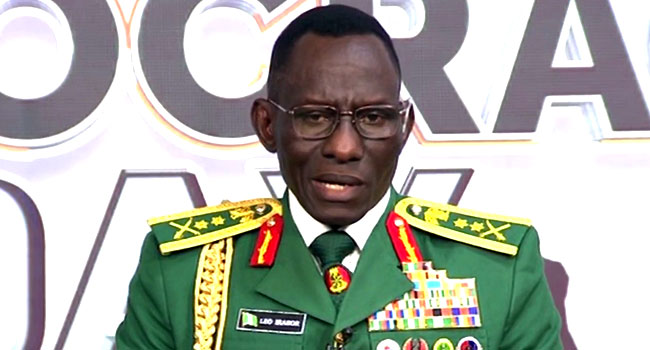
Former Chief of Defence Staff, General Lucky Irabor, has said some politicians are involved in funding terrorism in Nigeria.
Irabor made the comment on Monday during an appearance on Channels Television’s Politics Today programme, where he discussed the nation’s rising insecurity.
Asked if politicians fund terror groups, Irabor replied, “Some politicians.”
He explained that certain political actors exploit insecurity for personal gain.
“Some politicians have not taken advantage of the state of under governance, as it were, to perhaps gain some form of leverage to give the impression that they can do better.
“Others perhaps want to give an impression, to score the point that there is poor governance, they could also instigate a certain crisis in one way or the other. Those who believe that it’s purely political, maybe, have their argument from that angle. For me, it will be wrong,” he said.
READ ALSO: It’s Impossible For Repentant Boko Haram Members To Join Military – Ex-CDS Irabor
Irabor also addressed criticism about the government’s alleged refusal to publish the names of those allegedly funding terrorism.
He said investigators have questioned several individuals, but the information remains classified.
“I believe there are a lot of individuals who have been called to question. It’s not for public consumption, what I think we should do at this point is to give support and trust those who have charged that they will do what’s right,” he said.
Irabor added that Nigerians must understand that “Not everybody in government is a liar, is unserious.”
He also said there is a major gap in “manpower and equipment” and the country needs to do better.
Addressing the rise in attacks, Irabor said the pattern is not new. He noted that recent attacks are not new but appear worse because criminal groups now have access to more advanced tools and weapons.
“There is nothing new. Perhaps one may assume that it’s new is the fact that there are external dimensions. Because there are newer ways, tools available to these criminal elements, that is the reason why not only did the number increase, but also the violence that they unleash on the people has also changed.
“Over a long period, we thought that we were on the winning streak… then suddenly we now found that it is like we have reversed all the gains that we have made, and it’s so worrisome,” he said.
Gaps In Security Efforts
The former defence chief said Nigeria still faces major gaps in manpower and equipment, and he urged authorities to address these shortcomings.
Irabor said recent attacks reflect governance failures, noting that Nigeria must treat security as a national, not regional, issue.
He said violence has increased because criminal groups now use more advanced tools.
He warned that Boko Haram and ISWAP ideologies still influence communities, adding that “repentant insurgents cannot be recruited into the military.”
Surge In Attacks
Recently, there’s been a wave of insecurity marked by mass abductions and deadly attacks across the northern and central regions.
In November alone, several states witnessed high-profile attacks. These included the kidnapping of more than 300 students and teachers from a Catholic school in Niger State and the abduction of 25 schoolgirls in Kebbi State.
Armed groups also stormed religious sites, abducting worshippers from a church in Kwara State, a pastor and congregants in Kogi State, and several women from a bridal party in Sokoto State.