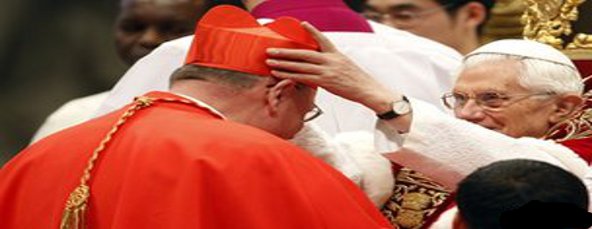
 Pope Benedict on Saturday elevated 22 prelates to the rank of cardinal in the Roman Catholic Church at a solemn ceremony in St Peter’s Basilica.
Numerically, at least, the pope has increased the chances that the next pontiff will be a conservative European but there have been surprises in past conclaves.
The pope is a conservative on matters of faith and sexual morals such as birth control, homosexuality and the ban on women priests. Each time he names cardinals he puts his stamp on Roman Catholicism’s future by choosing men who share his views.
Besides Dolan, other prominent new cardinals are John Tong Hon, archbishop of Hong Kong, and Rainer Maria Woelki, archbishop of Berlin in the pope’s native Germany.
Seven of new “cardinal electors” under the age of 80 are Italian – six of them members of the Vatican’s central administration and the other the archbishop of Florence.
Popes usually reign for life but in a book last year, Benedict said he would not hesitate to become the first pontiff to resign willingly in more than 700 years if he felt himself no longer able, “physically, psychologically and spiritually”, to run the Catholic Church.
Several popes in recent history, including the late Pope John Paul, considered resigning for health reasons, but none did so.
The last pope to resign willingly was Celestine V in 1294 after reigning for only five months. Gregory XII reluctantly abdicated in 1415 to end a dispute with a rival claimant to the Holy See.
The pope’s health is good but he needs to conserve his strength says the Vatican. Last October he started using a mobile platform which aides use to wheel him up the central aisle of St Peter’s Basilica.
Here are the names of the new Cardinals:
Under 80 years old and eligible to enter a conclave to elect the next pope:
1. Archbishop Fernando Filoni, Italian, prefect of the Vatican’s Congregation for the Evangelisation of Peoples.
2. Archbishop Manuel Monteiro de Castro, Portuguese, head of Vatican office that deals with the sacrament of penance.
3. Archbishop Santos Abril y Castello, Spanish, archpriest of the Rome basilica of Santa Maria Maggiore.
4. Archbishop Antonio Maria Veglio, Italian, head of the Vatican’s Council for Pastoral Care of Migrants.
5. Archbishop Giuseppe Bertello, Italian, governor of Vatican City.
6. Archbishop Francesco Coccopalmerio, Italian, president of the Pontifical Council for Legislative Texts.
7. Archbishop Joao Braz de Aviz, Brazilian, prefect of the Vatican’s Congregation for Consecrated Life.
8. Archbishop Edwin O’Brien, American, Grandmaster of the Equestrian Order of the Holy Sepulchre in Jerusalem.
9. Archbishop Domenico Calcango, Italian, President of the Administration of the Patrimony of the Holy See.
10. Archbishop Giuseppe Versaldi, Italian, president of the Vatican’s Prefecture for the Economic Affairs of the Holy See.
11. His Beatitude George Alencherry, Indian, major archbishop of the Siro-Malabar rite in India.
12. Archbishop Thomas Christopher Collins, Canadian, archbishop of Toronto.
13. Archbishop Dominik Duka, Czech, archbishop of Prague
14. Archbishop Willem Jacobus Eijk, Dutch, archbishop of Utrecht, Netherlands.
15. Archbishop Giuseppe Betori, Italian, archbishop of Florence.
16. Archbishop Timothy Michael Dolan, American, archbishop of New York.
17. Archbishop Rainer Maria Woelki, German, archbishop of Berlin.
18. Archbishop John Tong Hon, Chinese, archbishop of Hong Kong.
——-
Over 80 and therefore not eligible to enter a conclave:
1. His Beatitude Lucian Muresan, Romanian, major archbishop of Fagaras and Alba Iulia in Romania.
2. Father Julien Ries, Belgian, professor emeritus of religious history at the Catholic University of Louvain.
3. Father Prosper Grech, Maltese, professor emeritus of various Italian universities.
4. Father Karl Becker, German, of the Gregorian University in Rome.