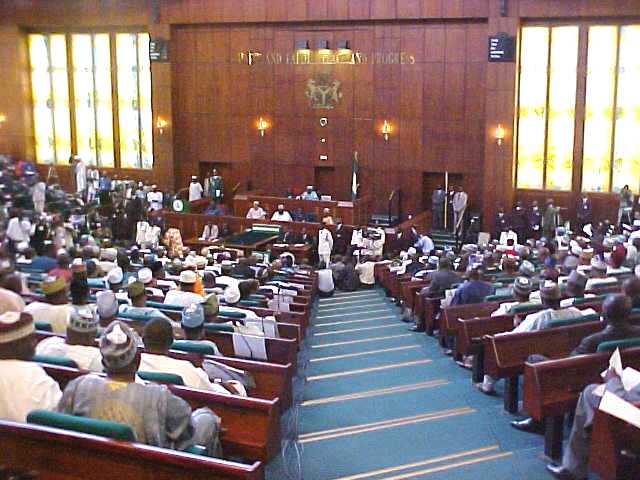
The House of Representatives on Monday threatened to impose sanctions on foreign airlines (British Airways (BA) and Virgin Atlantic) for flouting aviation laws in their manner of charging exorbitant fares on Nigerian air routes.

The Chairperson, House Committee on Aviation, Nkeiruka Onyejoacha issued the threat at a meeting with international airlines. The lawmaker expressed displeasure with the airlines’ hidden taxes (including $508 fuel surcharge) and discriminatory charges totalling $969.24.
Representatives of Lufthansa, Air France/KLM, Virgin Atlantic and British Airways were present at the meeting with the House of Representative committee on aviation.
Mrs Onyejeocha said that the airlines “must” reduce their fares or face backlash from the legislature.
“Nigerians are suffering and you are not treating us well. We are interested in price reduction. If you are not going to do that, tell us and we will impose sanctions; we are not interested in your story of demand and supply,” she said.
She said that although Nigeria is a free market economy, air fares in the country have been the highest within the West Africa sub-region.
“Within the last few months, airlines flying international and domestic routes have increased their fares many times, and in most cases, without prior and adequate notice to travellers. We, as a nation, must curb and resist this trend,” she said.
“These arbitrarily fixed airfares are exploitative, particularly as Nigeria’s aviation fuel is one of the cheapest in the market as against what is obtainable in countries such as China, India, Ghana, and United States of America. We have discovered that Nigerians pay higher to travel to places like Europe and America, while other countries attract cheaper fares even when the distance from such countries is farther than Nigeria.
“This exploitation must not be allowed to continue, more importantly as Nigeria is one of the most lucrative routes in the world with a minimum of 1,000 passengers coming in and out every day.”
Speaking at the meeting, the President of Association of Travel Agencies, Aminu Agowa said that travelling tickets worth over $1 billion were raked in last year without corresponding profits to the 600 licensed travel agents. “Hidden taxes constitute 50 per cent of the total charges imposed on travellers, and most of the tickets displayed on the internet by the foreign airlines are not sellable,” he revealed.
The Director General of the Nigeria Civil Aviation Authority (NCAA), Harold Demuren, said that airline agencies for indulging in sharp practices.
Mr Demuren said that there is a disparity of $4,239.27 in the amount charged on first class flights between Ghana and Nigeria, $1,055.22 on business class/club between Ghana and Nigeria, $92.02 on premium economy between Ghana and Nigeria; while economy class was $233.13 lower than the fare charged in Nigeria.
“We have done the study and we have all the figures; we have the details. We have been on this for the past two years and every Nigerian who has been ripped off must be paid back,” he said.
“I want to beg the House of Representatives to take on the travel agents because, technically, they are the ones involved. They will tell you the tickets are not available. It is the normal practice in the business, but it is unfair.
“Specifically, both airlines (British Airways and Virgin Atlantic) colluded to fix the passenger fuel surcharge in a manner that eliminated or suppressed choice and competition, and the Nigerians were the victims of this conduct while both airlines reaped huge profits from their misconduct.
“For these violations, the NCAA imposed monetary penalties and decided that passengers who were exploited must be compensated. With respect to NCAA’s factual allegations and findings that both airlines engaged in deception, collusion (price fixing) and unfair methods of competitions, the panel found out that all the allegations were sufficiently established by overwhelming evidence.”
Read the complete presentation of the DG, Nigeria Civil Aviation Authority, Here.
British Airways’ country director, Kola Olayinka, declined to comment on the issue saying that he would be breaching the European Anti-Trust Regulation if he responded.