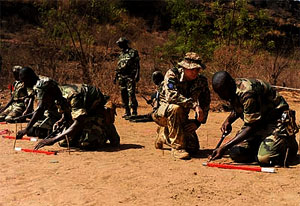
 The European Union has stated its commitment to help in rebuilding the Malian Army as it launched a training mission which foresees a considerable challenge in seeking to succeed where years of U.S. instruction failed by turning Mali’s rag-tag army into a force capable of facing an Islamist threat stretching across the Sahara.
Years of corruption and neglect led the army to a string of defeats against al Qaeda-linked militants last year, leaving northern Mali under Islamist control and sparking a military coup by disgruntled officers in the capital, Bamako.
Only a lightning intervention in January by France – which warned that the al Qaeda enclave posed a threat to Europe – dislodged the well-armed Islamist fighters from northern Mali’s towns.
Paris now plans to pull out most of its troops and hand over to a United Nations peacekeeping force.
But the EU overhaul of Mali’s army – one battalion of 700 men at a time – is at the heart of long-term efforts to keep the nation’s desert north free, not only of Islamist militants but also of traffickers ferrying cocaine, contraband and illegal immigrants into Europe.
EU officers are also working in the army headquarters to audit and strengthen the chain of command, which ruptured when junior officers toppled the president in a coup in March last year.
General Carter Ham, speaking in January before handing over leadership of the U.S. military command in Africa, recognised the United States had failed during years of counter-terrorism training in Mali to pass on.
Whereas U.S. instructors focused on training individuals in strategy and tactics, the EU’s priority is forging units from scratch and building cohesive units.
But the 12.3 million euro EU programme will train just 2,100 men, and questions are being asked about who will complete the job. After the army lost much equipment to advancing rebels, the costly task of kitting it out must also be addressed.
The EU cannot provide hardware but is acting as a clearing house for donations from France, Belgium and Cyprus.
EU officials say they are building on their success in training 3,000 Somali soldiers in Uganda to form the core of the national army which, alongside peacekeepers, has pushed back al Qaeda-linked militants.